Written by Martin O’Neill, Artistic Director of The Stove Network, this piece reflects on The Show Must Go On – a temporary public artwork developed through the Hear Here project. Drawing on conversations with Showpeople and townsfolk, it traces the life of the sign, the traditions it held, and the questions it leaves behind.
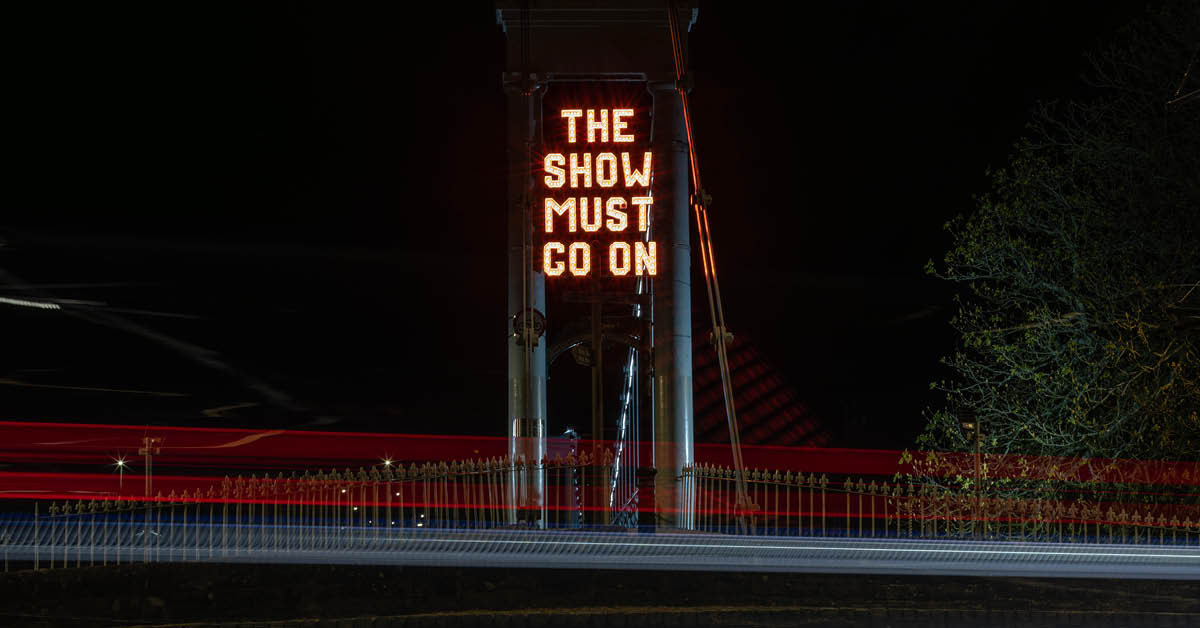
On the 31st of March 2026, the illuminated artwork above the Whitesands entrance to the Suspension Bridge came down.
It’s been there for just over a year. Installed in March 2025, it quickly became part of the everyday – something you might pass without thinking, or stop and look at depending on the day you were having.
For some, it felt like a small beacon – a message of hope or resilience. For others, its position above the bridge carried a different weight, something significant about it above the threshold of one side of Dumfries and another.
Its origins and meaning were intentionally left open. There was no white plaque explaining who made it, where it came from, or interpretation. Instead, it was allowed to settle into the rhythm of the town more naturally.
That openness made space for people to meet it in their own way. Whatever meaning you found in it at the end of a hard day, or in the half-light of a winter morning, was valid too.
As the Spring Fair departed, the sign too with it.
But its story, and the context it lived within, continues.
The Site
The Suspension Bridge opened on New Year’s Eve in 1875. Designed by engineer John Willet of Aberdeen, it also carries a quieter local connection – Dumfries architect James Barbour, brother of Robert Barbour who founded the town’s well-known department store, is known to have produced an alternative design for the bridge, the drawings now stored in the Dumfries Museum.
Like many civic projects of its time, the bridge is understood to have been supported through a combination of public funds and local contributions. There are stories, still told, that travelling Showpeople – including the Biddall family – played a part in that.
Whether documented or carried through stories passed down, the link holds weight. Their site sat right at the foot of the bridge. Any contribution may also speak to something cultural: a way of strengthening the legitimacy of their business and their place within the town. A quiet assertion of visibility towards more established recognition.
That thread, of those often seen as outsiders contributing meaningfully to a place’s cultural life, continues strongly today within the Showpeople. Financing the construction of a bridge is not only symbolically fitting – a threshold between one place and another – but also something more enduring. Unlike the transient nature of the fairs, it is fixed.
Stories passed down speak of mill workers crossing the bridge in metal-soled clogs – the sound of them striking the deck ringing out, and, in some records, even throwing sparks as they went.
Like many suspension bridges it was known to sway under the weight of heavy footfall, anyone crossing today with more than 2 people to this day can attest to this. Fitting too, given its role as a passage toward the fairs, with the bridge’s sway foregrounding the thrill of the rides.
The Makers
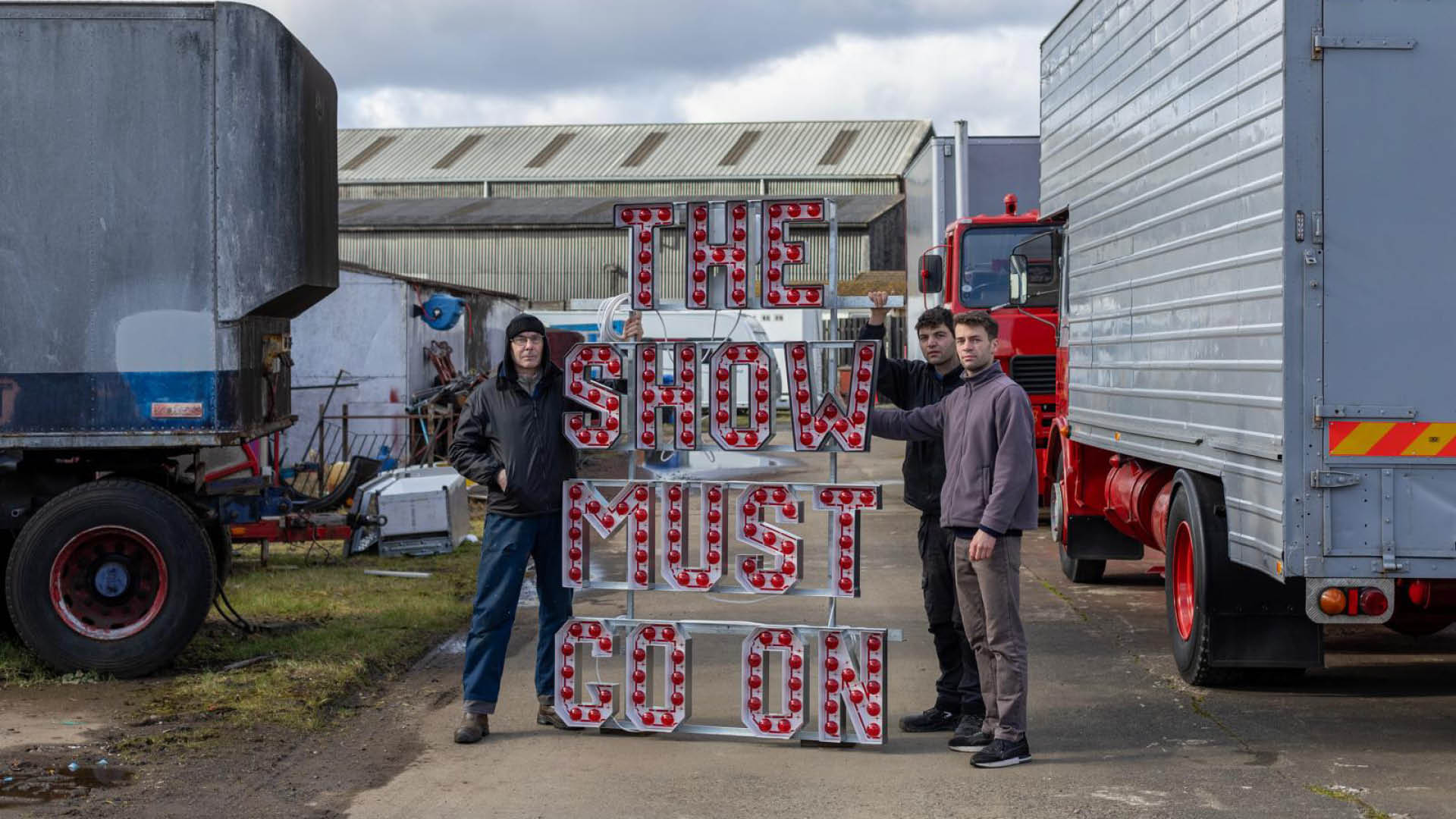
Thanks to our partnership with Fair Scotland, a maker was quickly identified from within the Showpeople – a community whose deep-rooted skills in artistry, engineering and mechanics form a living thread passed from one generation to the next. It felt important to honour that knowledge in the making of the work, rather than outsourcing it to conventional arts fabricators.
After all, this is a community whose livelihood is built on precisely the skills needed to make something like this.
Working from an original design of my own, the initial sketch was placed in the hands of Preston Irvine – a maker whose reputation precedes him. Preston is known for an exacting attention to detail, a standard of care that reveals itself in the quiet authority of his amusements. Walk through the Rood Fair and you’ll see it: the Irvine family’s amusements gleam. There’s a finish to them – a polish that only comes from years of lived craft. The murals are hand-painted, rich with character and precision. The typography is composed – intricately weaving through the banners and decorative fronts. Not a single bulb is out; each light calibrated and sequenced. Every surface, every detail, carries the mark of someone who not only knows their trade, but honours it.
Of course, across the fair, every ride holds its own story, its own significance and personality. But there is something distinct in Preston’s work – something rooted in a more traditional sensibility. Not antiquated, but a living craft: an unbroken thread of care, artistry, pride and love, carried forward through generations. Evident too through his sons, Mitchell and Wallace, whose same attention to detail rivals their father’s. It’s the kind of attention that might often go un-remarked – but it’s that kind of enduring, quiet care that threads through the fairs themselves.
Among fellow Showpeople, there’s a general recognition of this commitment. It’s often said that Preston’s rides are the first to arrive and the last to leave – a reflection not just of work ethic, but of a deep sense of responsibility to his craft and the communities it serves. Even alongside the spectacle of the waltzers or the dizzying scale of newer attractions, there’s something about the Irvine rides that holds its ground – unmistakably made.
I first met Preston by chance, on the bridge itself – his finely tuned gaze tracing the lines between its columns, standing among some of the old guard of the Shows: the Biddalls, the Millers.
As we walked and talked through the practicalities of the installation, the morning was bright and clear, the second day of the Rood Fair, alive with that familiar hum of anticipation and nerves, the question hanging in the air: would the weather hold, would the punters come?
What followed were visits to Preton’s yard, out near Dalmarnock – a more permanent base for Showfamiliies, and not quite what you might expect. The mobile homes read more like suburban bungalows: tended gardens, street signs, manicured hedges, even the odd garden gnome – all the familiar markers of settled life.
Look closer, though, and another reality reveals itself. Beside each neat lawn sits a generator; within each home, hydraulic systems allow the structure to contract and expand. It’s not quite a Transformer situation – more like if Optimus Prime revealed his true form as a semi-detached with Sky Sports and an electric thermostat. And yet, still somehow heroic.
There’s a quiet tension in that duality, a sense of semi-permanence. As if, at any moment, the land could be sold from beneath them, and an entire community would have to move on. It speaks to the underlying precarity of Showpeople’s lives in Scotland – settled, but never fully secure.
During one or two visits, these feats of engineering became more and more the norm. The family were midway through an impressive new build – a home for their son and his soon-to-be wife – complete with hydraulics and mind-boggling joinery. In that moment, any nerves there might have been about the ins and outs of the sign gently lifted and the reality of what we were doing settled in, albeit disquietly.
During this time, the Whitesands Flood Defence scheme became a constant undercurrent – a footnote to every conversation. How far could we take this? What were we really trying to say? Tensions in the town were rising – for and against – and the truth was, and still is, that no one fully knows what this development will mean for the Showpeople, or for Dumfries itself.
Between us – Fair Scotland and The Stove – we held a clear intention: to amplify the voices and cultural heritage of the Shows in Dumfries. These are traditions that stretch back to the medieval era, but more than that, they carry a living thread of memory – passed from one generation of Doonhamer to the next. And in that, our resolve only strengthened. We stood united.
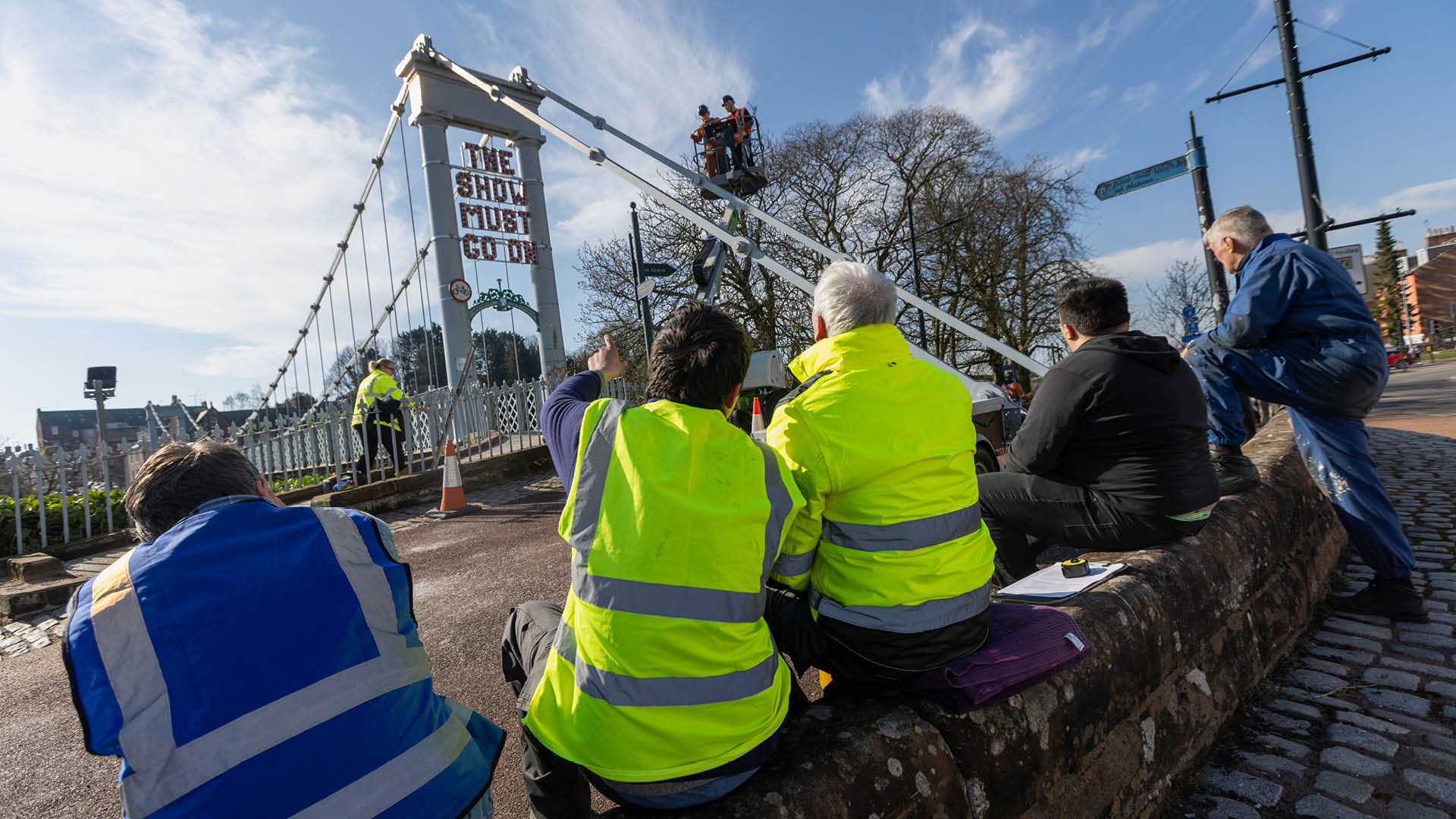
The Installation
There’s nothing quite like the installation of a new work. The air is thick with nerves – despite measurements triple-checked, permissions secured, road closures confirmed, equipment in place, contractors briefed – the sense that something might still go wrong hangs everything on a knife edge.
Due to illness, much of the fabrication fell to Preston’s sons, Mitchell and Wallace, an impressive feat given their age, though both have lived and breathed this work since childhood. In Showland, a documentary by Mitch Miller screened at the Stove the week following – filmed ten years earlier – they appear as boys, already at their father’s side, practicing these very skills.
The confidence was there but even that couldn’t quite settle the nerves of installing a new work onto a listed structure in the heart of the town.
Thanks to local engineer James Bell and his family, alongside Steven Millar (J.C Martin) – and the now-renowned ‘Nifty One Fifty’ – the work went up without a hitch.
What stood then was for the town to make of it.
As dusk settled over the river, the lights came on for the first time. Sitting at the foot of the bridge, I watched as people gathered – pausing, staring, posing, questioning this new apparition. And as the evening deepened into autumn’s night, its message began to shift – less a statement, more a question… or an invitation.
A Year Above The Bridge
Launched as part of the Hear Here project in October 2024, in partnership with Fair Scotland, what followed was a steady programme of events, talks, films and artworks, all centred on the Shows and their place within the town.
By the Spring Fair, the sign had been in place long enough to become a point of reference. Fair Scotland revived their Fairground Walkabout, gathering beneath The Show Must Go On as Showpeople and townsfolk came together to listen, discuss and share perspectives.
Alongside the public programme, the sign began to appear in everyday ways – in photographs, on social media, in the background of nights out or walks along the river. From late-night selfies to quick snapshots taken in passing, it entered into the visual fabric of the town.
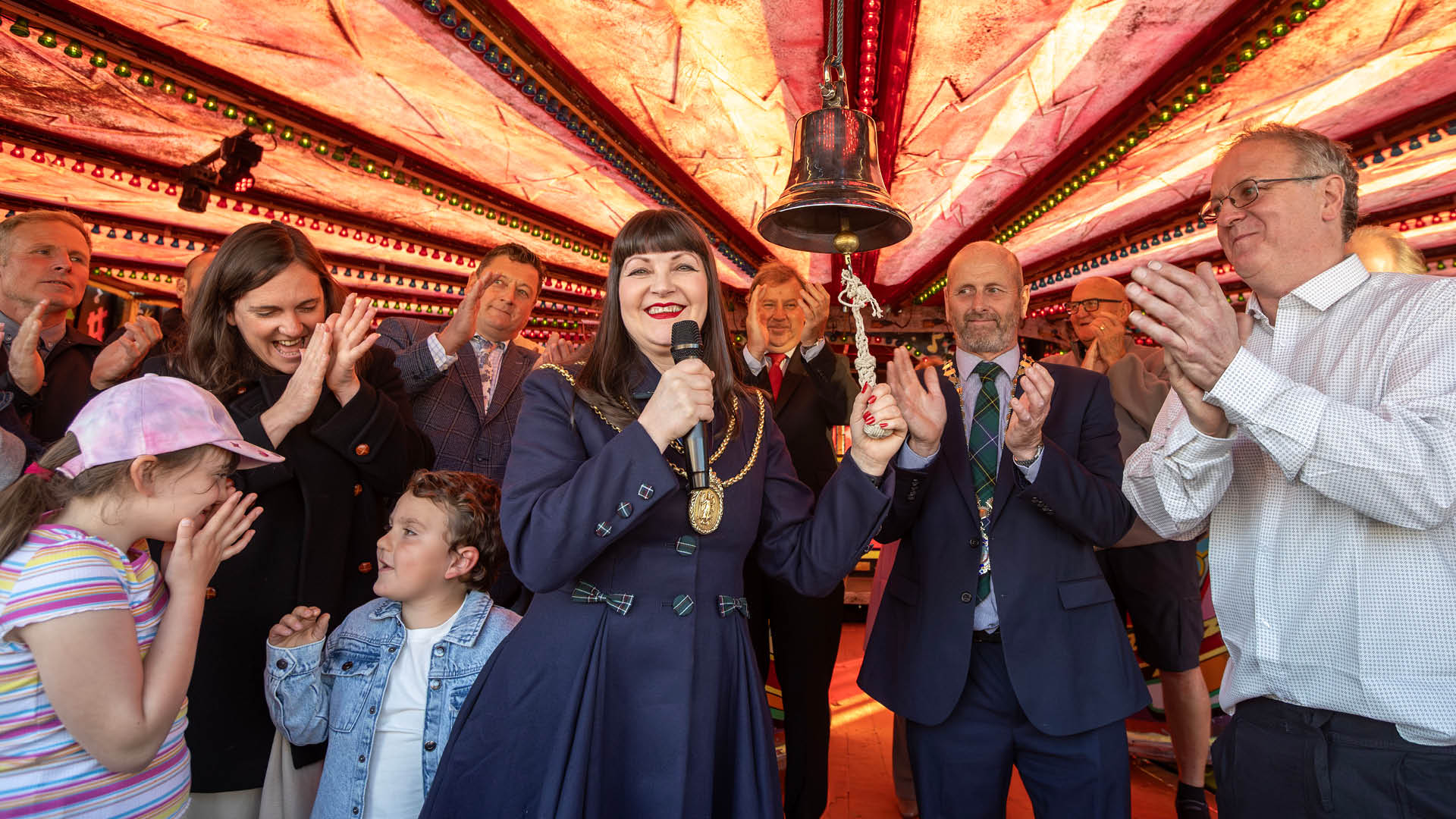
In September, beneath its glow, the tradition of “ringing in the fair” returned for the first time in 80 years.
Introduced by Provost Tracey Little, the moment carried both ceremony and memory. She spoke of the fair’s enduring place in the life of Dumfries – as something living, held and renewed by its people. Later, joining us at Fables, Fortunes and Futures, a temporary tarot-style booth set at the foot of the sign, she sat with townsfolk, sharing stories and listening in equal measure.
“The fairs will always be welcome here,” she said. “You will always be wanted, and you will always be important to the people of Dumfries.” Reflecting further, she added: “I hope to see and hear everything in the future. They move with the times, but not as fast as the times.”
Around her, others gathered to tell their own accounts. One participant arrived with four generations of their family, each carrying a different version of the fair, memories stretching back over 70 years, alongside those only just beginning.
These recordings would go on to form the bedrock of Phanto Spectra, premiered at Northern Lights in January, following support from Immersive Arts to develop the work as a prototype.
In spite of its short life as a site-specific work, The Show Must Go On settled quickly into the town’s consciousness. Not a single act of vandalism. It stood by the river like a kind of hearth – something that remained after the rides had packed down and the crowds drifted home. An ember before a flame.
When the sign came down, I talked with passers-by. There was a shared sense of loss, as if it had only just begun to root itself. People spoke of it as a landmark, a small destination, something you’d walk to or orient yourself by. I felt it too. It’s striking how quickly something becomes familiar – and how sharply its absence is felt. It’s a blunt comparison, but a fitting one: echoing the bigger conversation around the Whitesands, and the very real risk of losing the fairs altogether.
So, what happens next?
The story of the Showpeople in Dumfries is but one in Scotland. As an enduring business – and way of life – the Showpeople are no stranger to the themes of our times – development over heritage, regeneration amidst culture, and climate change versus justice. There is no easy strand to follow. What is demonstrated it seems is the Showpeople represent something united across society, there’s something human about how we mark our lives in the thrill of the rides and the glow of the lights – that all too often – we are restricted to performance indicators of success by the metrics of market-driven ideologies – as opposed to what we really want to do while we live – to have fun.
At a moment when so much of life is shaped by metrics, efficiency, and market logic, the fair offers something disarmingly direct: the chance to gather, to feel, to enjoy.
And as more of our lives drift toward the digital, towards forms of connection that pull us away from place, the fairs remain grounded. They ask us to show up, in real time, together. We shouldn’t take that lightly.
An emerging idea is to shift the sign from fixed to nomadic, reflecting the travelling Shows and the people who sustain them. From Kirkcaldy to Glasgow, St Andrews to Stranraer, the sign could move with the fairs from April through to September.
Fair Scotland’s red and black list of endangered and lost fairs comes back into view here. As well as appearing at active sites, the sign could also mark the places where fairs no longer arrive – a ghost sign, a quiet form of resistance.
As Hear Here begins to shift its focus toward working with New Scots in Dumfries, our engagement with Showpeople won’t disappear. It will continue in more strategic ways , building on what’s been learned to open up a wider, national conversation, and to connect its outputs to the broader questions shaping our times.
But for all the planning, there’s a noticeable absence above the bridge now. For those who pass through that space – day in, day out – it may feel a little different.
I hope the message holds, whatever it came to mean. On a difficult day, or at the end of a good one. In grief, or in hope. However it met you, I hope something of it stays.
The show must go on.