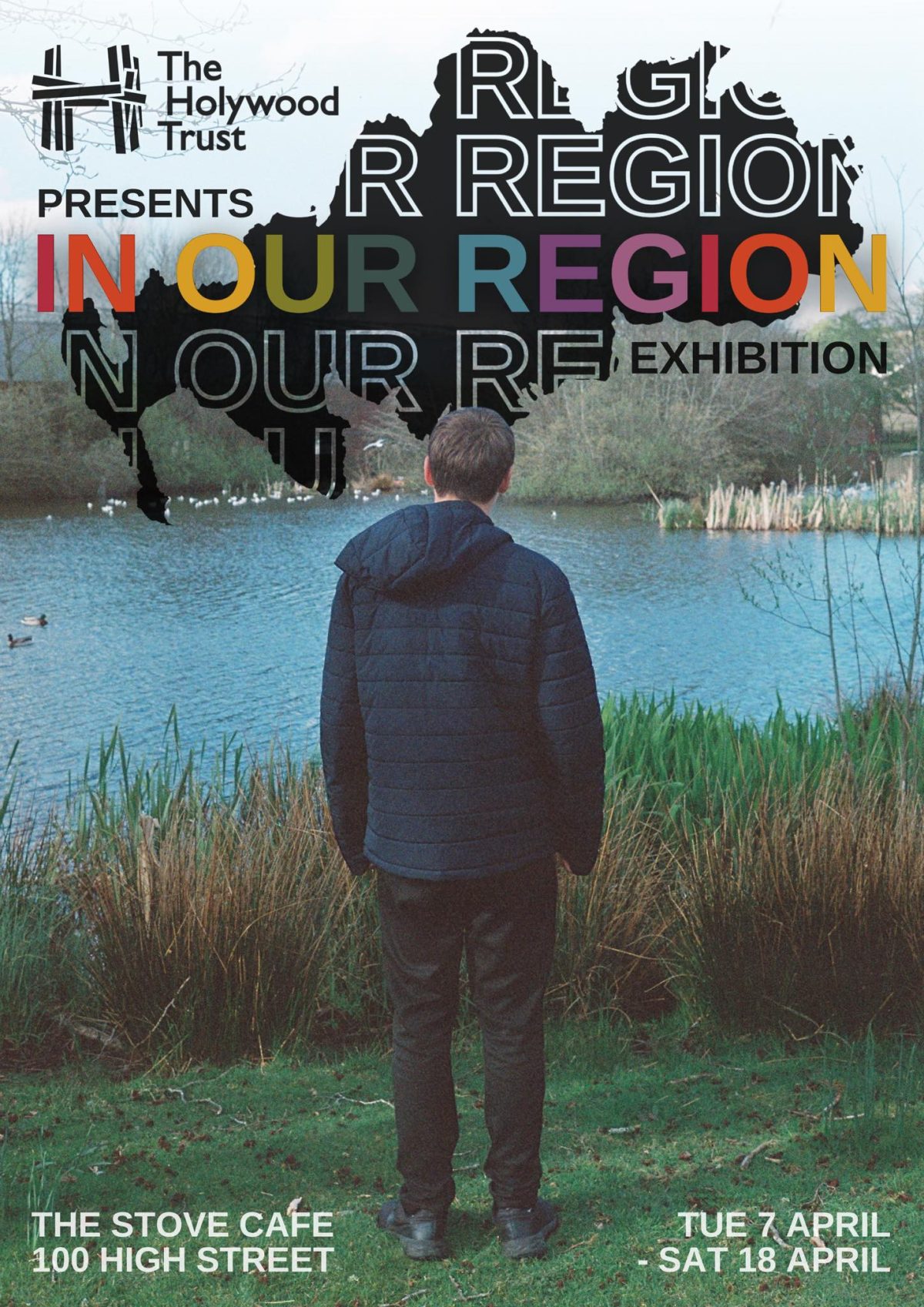
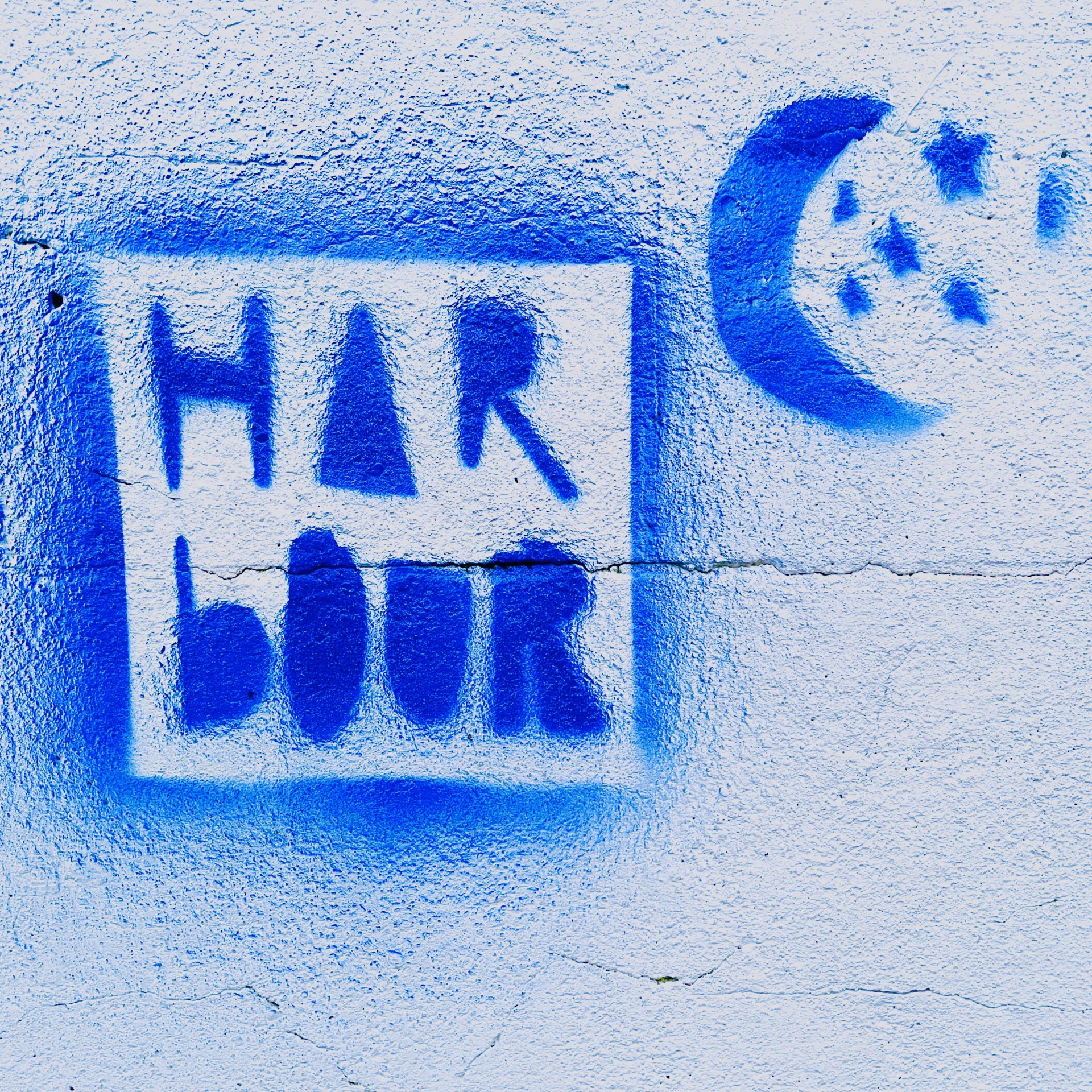
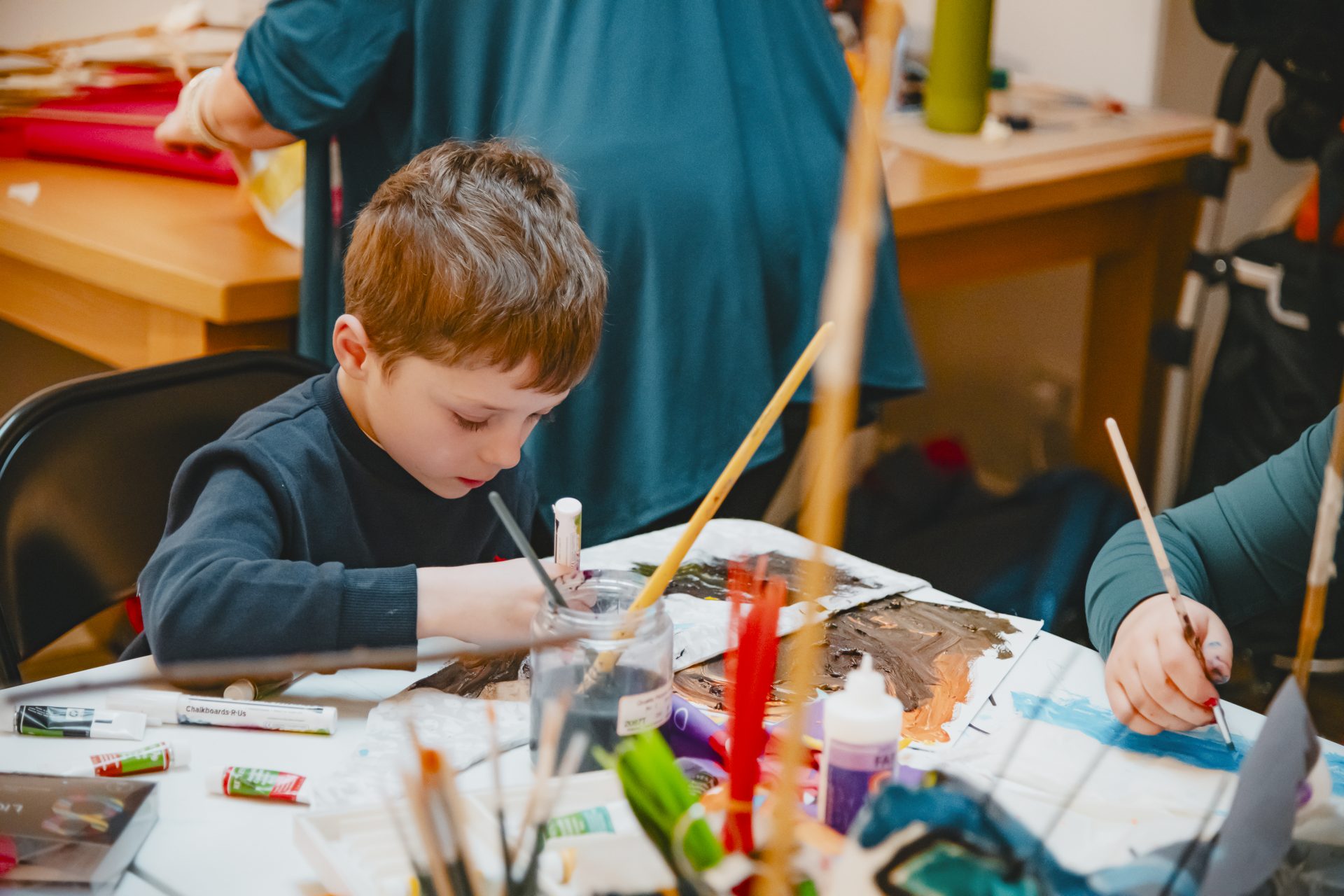
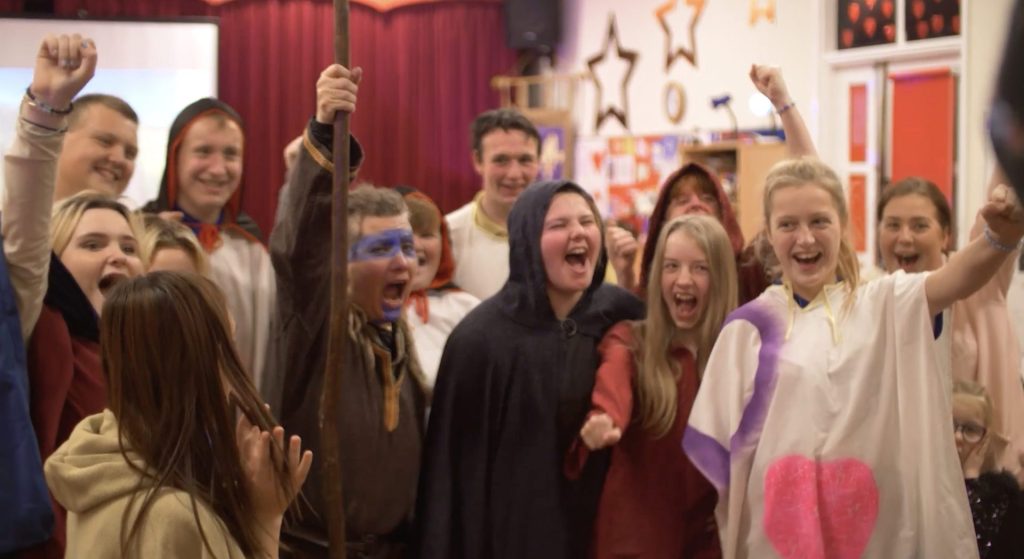
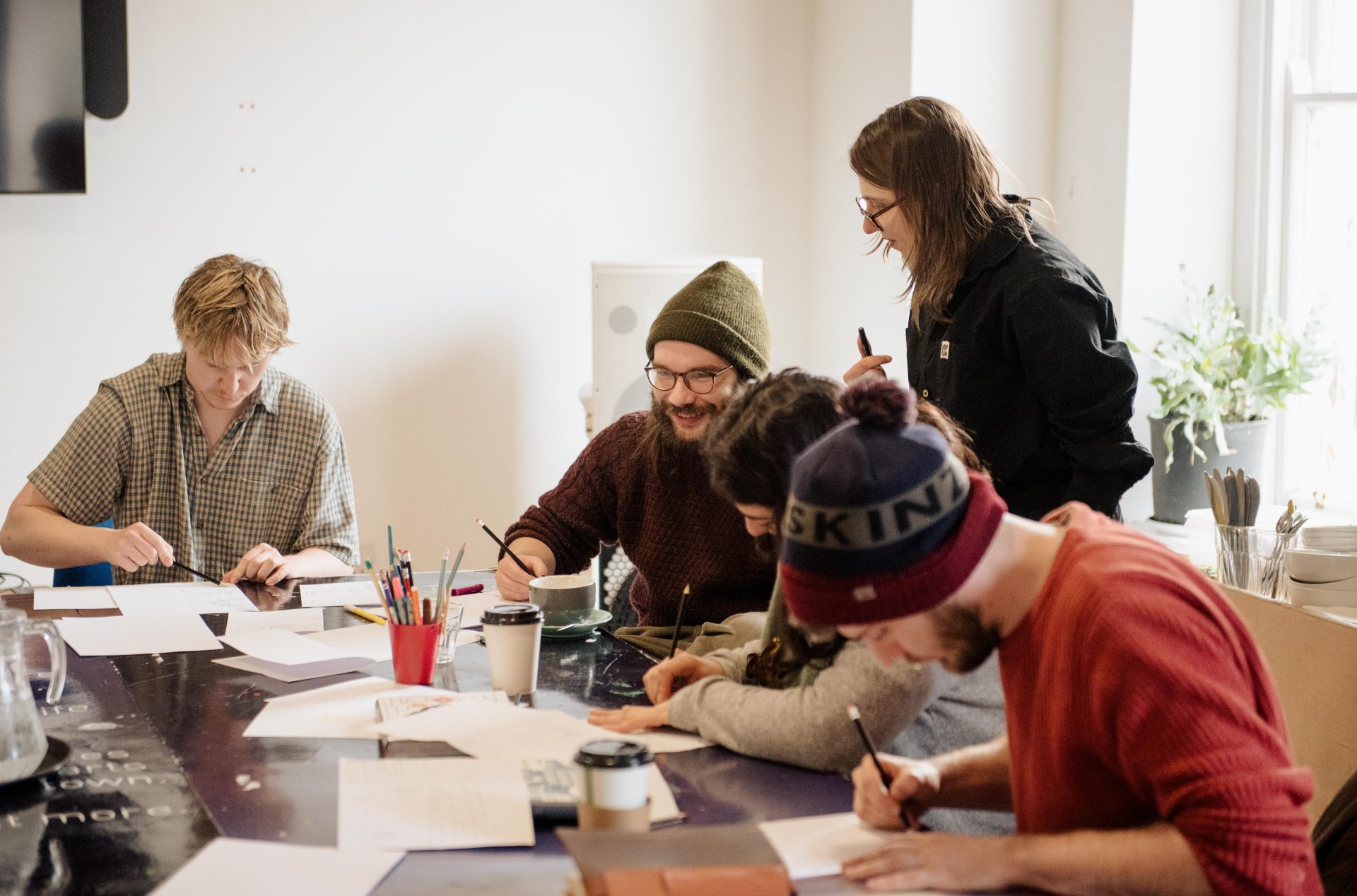
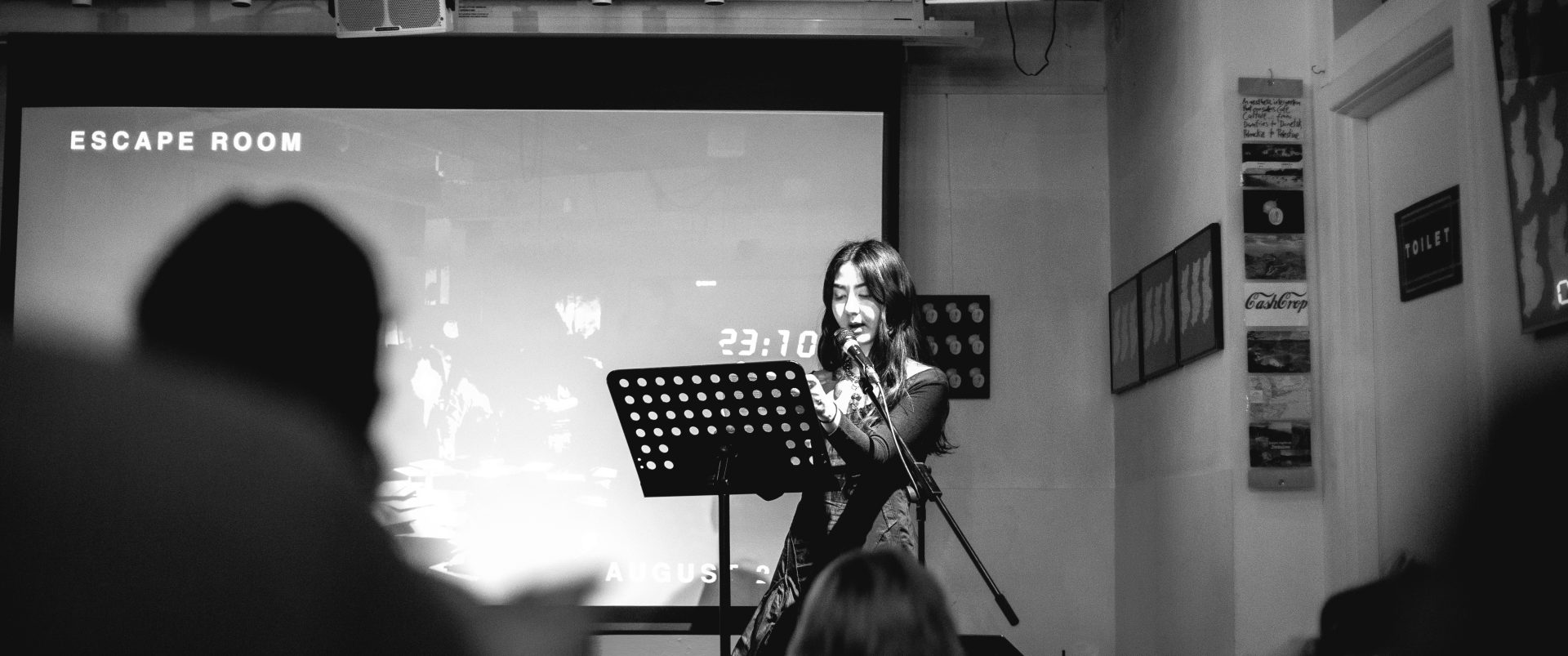
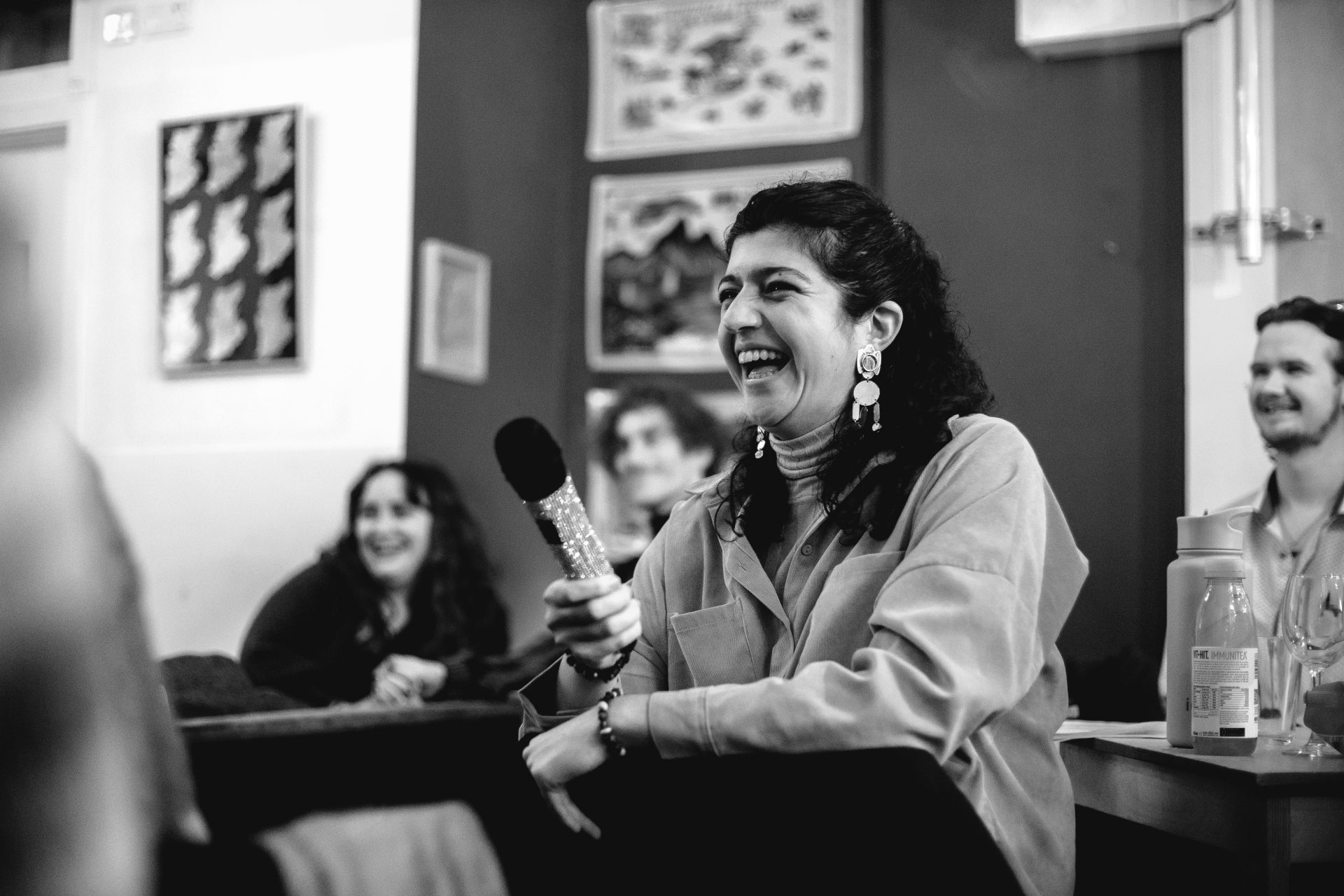
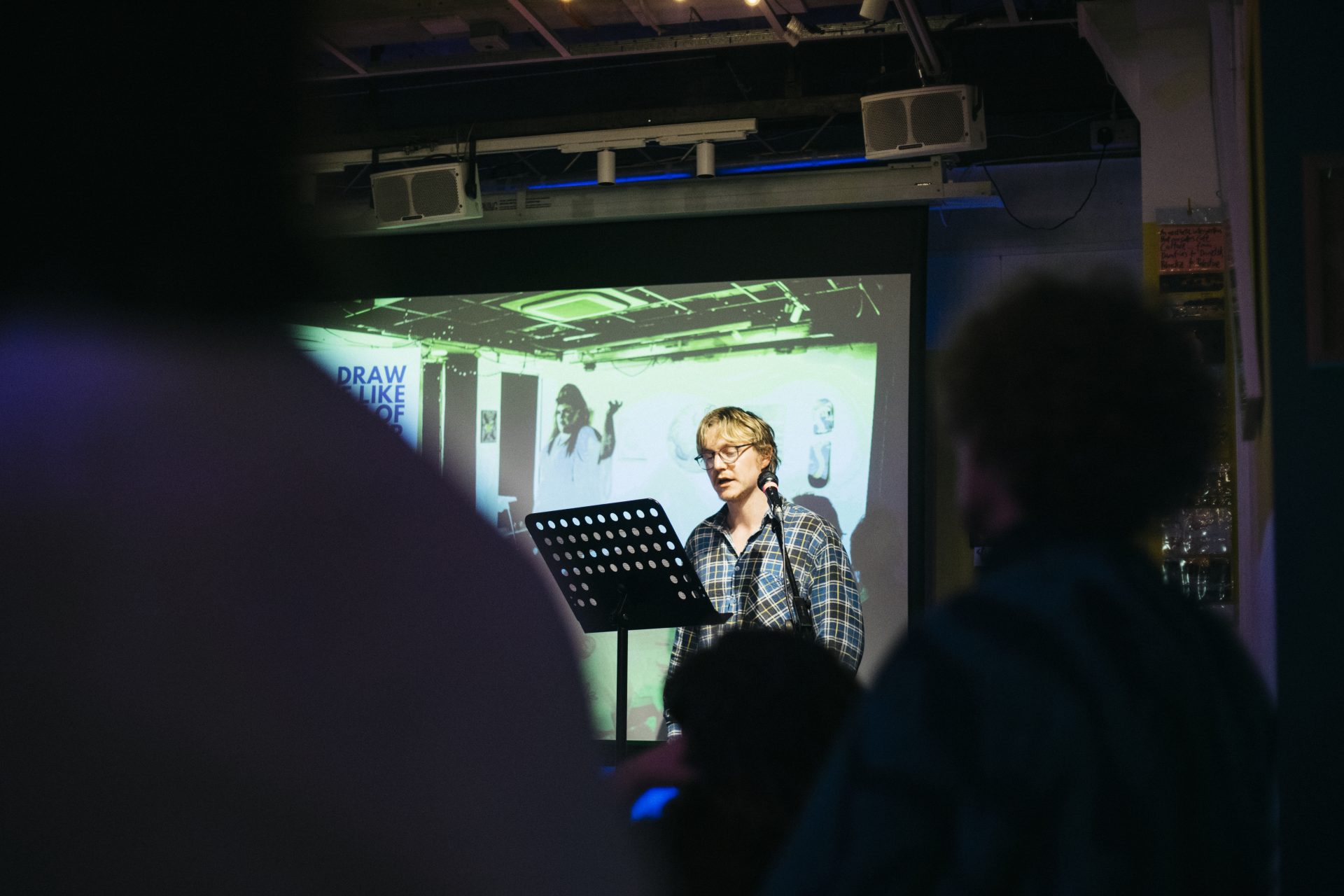
We’re excited to announce that In Our Region is coming to life as a pop-up exhibition in The Stove Network in Dumfries. Through open conversations and powerful image-based storytelling, the project connected with four young people from across the region to explore identity, belonging, lived experience, and what young people truly need from the places they call home.
Join us at The Stove Network, 100 High Street, Dumfries
Tuesday 7th April, 5.30pm – 7.30pm
The exhibition will feature: • Photography by Rhys Robert Thomson • Interviews with Jamie Morrison, Adam Molyneux, Eden Beck, and Josh White • Perspectives from Sanquhar, Whithorn, Annan, and Kirkcudbright • FREE refreshments • Space for conversation and connection
This is more than an exhibition, it’s a chance to listen, reflect, and celebrate the voices shaping our region’s future.
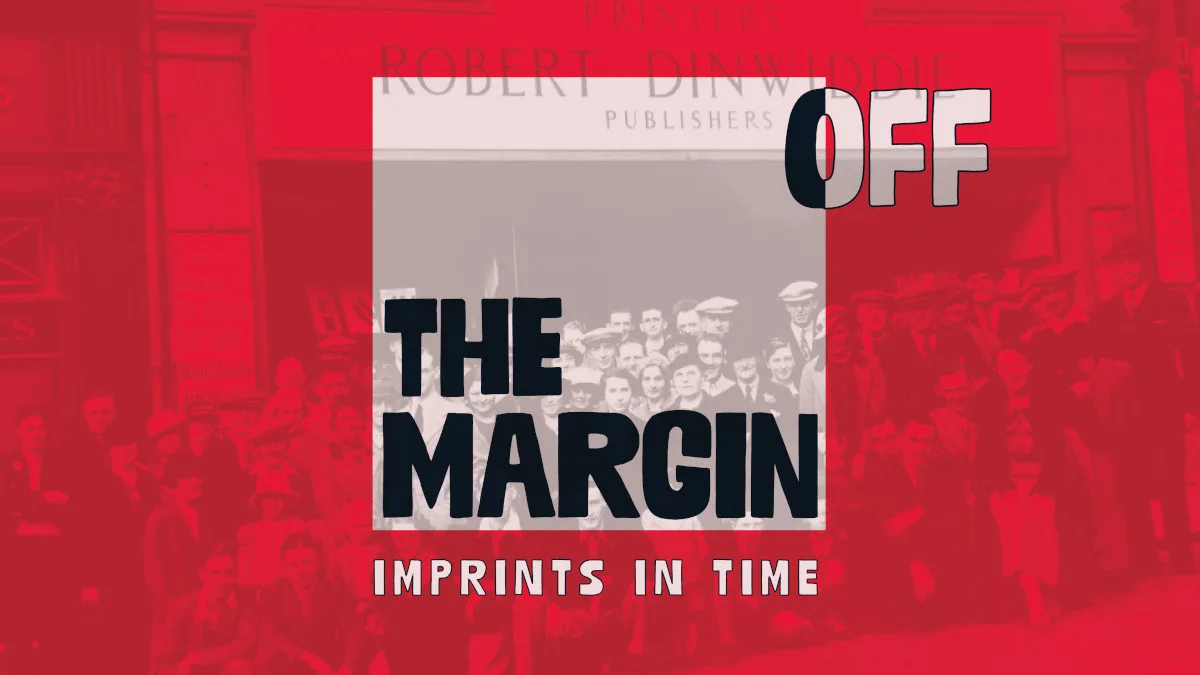
WWDN Digital works with community groups and organisations to set up and run digital spaces, host collaborative programmes, and create shared online resources to increase communities’ access to technology and training in digital media skills. As part of its launch, The Stove Network hosted Off the Margin, a micro-festival celebrating Dumfries’ print heritage.
In this age of digital media outlets and information sharing, Off the Margin delved into the print heritage of Dumfries and investigative journalism more broadly.
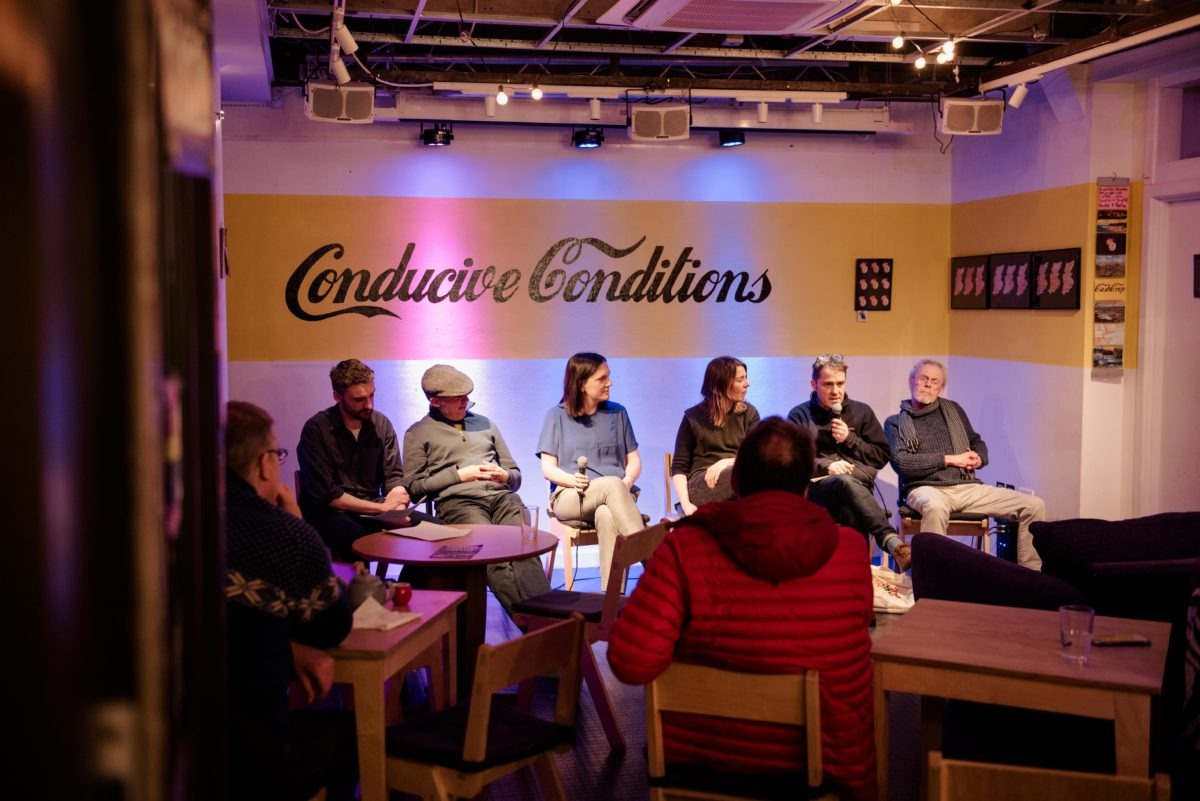
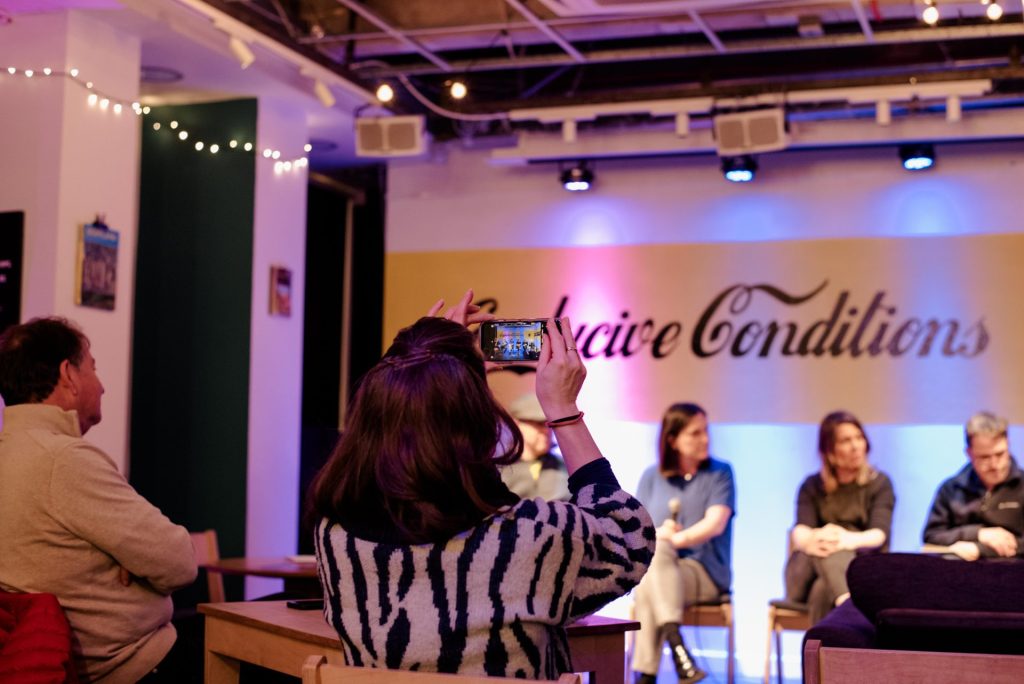
As part of this programme, The Stove’s Artistic Director Martin O’Neill sat down for an insightful discussion with a panel of speakers whose expertise ranged from the history of investigative journalism to Riso printing techniques and working in the former news and print spaces of Dumfries’ high street.
While examining the current landscape in Scottish grassroots print and journalism, the panel tackled how communities, creatives, and journalists can reclaim their agency while navigating an era marked by an increasingly divided mass media and heightened public scrutiny regarding the accuracy and biases of printed media. This discussion revealed insights and sparked a hopeful community discussion on the potential future of print, media, and journalism in Dumfries and Galloway.
The discussion directly followed a screening of film-work Imprints in Time by Artist John Wallace, documenting the master printmakers and enduring machinery still in use at Solway Print while uncovering the printing heritage of Dumfries town centre.
Each panellist brought unique and specialised knowledge into the discussion. Hewitt shared her expertise on the unique history of early print protest, bringing to life Doonhamers’ struggles and lived experiences in the late 18th and early 19th centuries. From historical accounts of the Kings Arms (now Boots) to outlining how individuals used print to protest food inequalities, Hewitt brought with her a wealth of knowledge that leaves you returning for more. Out with the panel, she oversaw the exhibition ‘Fighting for Justice: Strikes and Protests in Dumfries 1770-1920’ as part of the Off the Margin period.
Gailey brought over a decade of experience in printmaking and youth engagement to the conversation, underlining the importance of teaching young people this skill and providing them with the means and opportunities to grow their confidence and creativity. At Out of the Blueprint, the eco-studio he co-manages in Leith, Edinburgh, he specialises in Japanese printing techniques such as RISO, GOCCO, and provides mentorships for young artists. They offer affordable, sustainable, and ethical print services for the local community and reinvest all profits to support young people through residencies, publishing support, training, and education initiatives.
Goodwin works as a journalist and a co-editor for The Ferret, a media co-op where she reports extensively on social affairs and health inequalities. While on the panel, she highlighted the importance of community-owned news for tackling media bias and misinformation. Outside The Ferret Goodwin has written for many Scottish and UK broadsheets, magazines, and online platforms, including the Sunday Times and the Guardian, reported for BBC Scotland’s Disclosure, and has worked on other radio and film projects. She is currently writing and co-hosting the podcast ‘Sheku Bayoh: The Inquiry’.
Fortune’s working life began in the printers of Dumfries, having grown up in a golden thread family line of Doonhamer printmakers. Pete Fortune brings a vivid, real-life account of the industry, capturing his apprenticeship and the vibrant characters and community of the town at the peak of the printing era. He rounded the discussion out by proposing the lifelong fellowships that printmaking can craft. Fortune moved on in his career to become a social worker and is now a writer of memoirs and short fiction.
Wallace, the artist behind Imprints in Time, brought to the panel a career that expands across multiple disciplines, from installation work to filmmaking. His work delves into human relationships with constructed and natural environments, emphasising the idea of ‘insider art’, allowing locations that personally connect to the artist to be central to a film’s narrative. Inspired by the fusion of technology and the environment, Wallace incorporates live and historical data sources to craft the responsive, dynamic audiovisuals found in Imprints in Time and all his installation spaces.
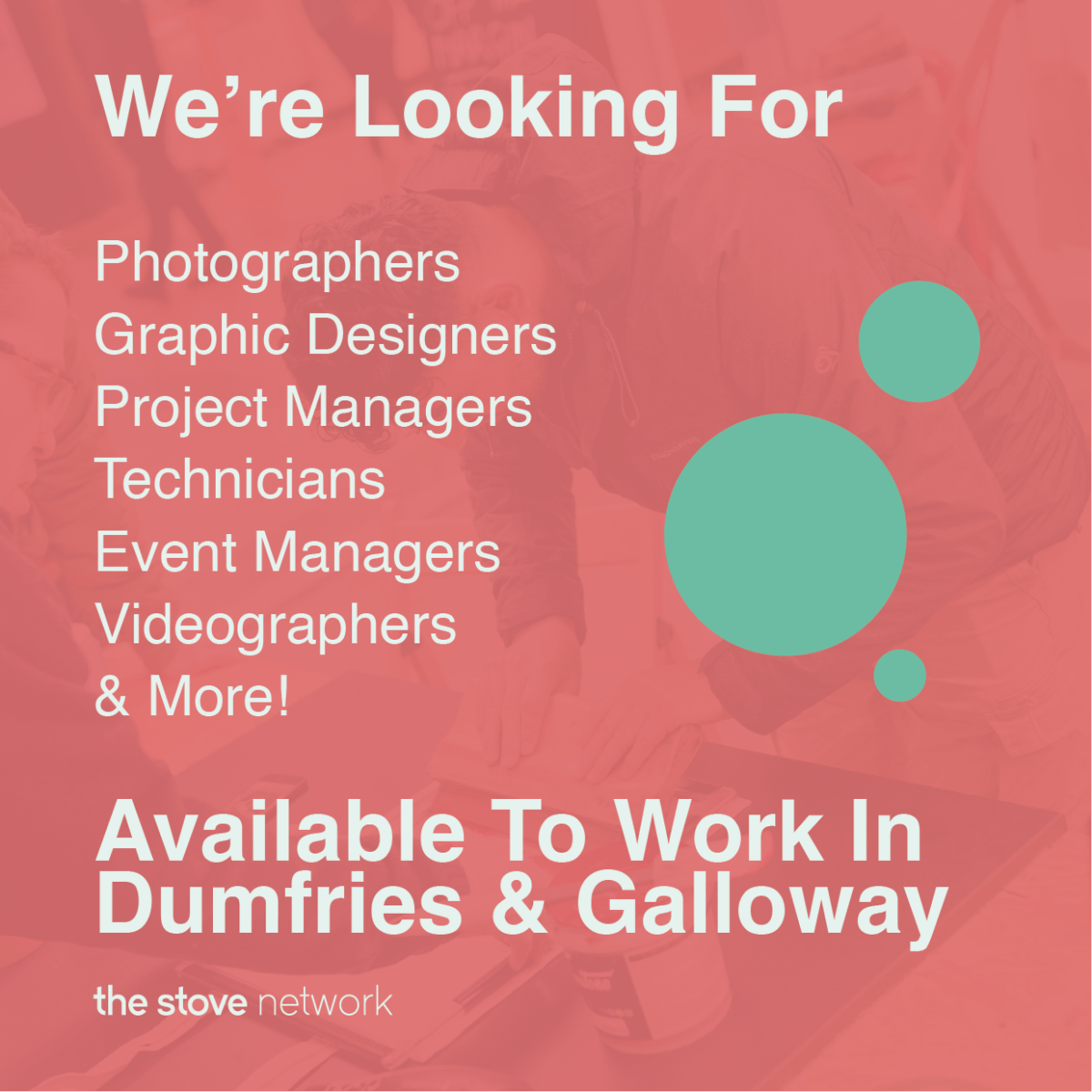
As a dynamic organisation with a diverse range of projects across the region, we’re always eager to collaborate with talented freelancers. Whether you’re a photographer, graphic designer, communications expert, project manager, technician, or possess other specialised skills, we want to connect with you.
Our work is primarily based in Dumfries & Galloway, so we’re particularly eager to connect with freelancers from the region—whether we’ve worked together before or you’re new to us. If you’ve recently reinvented yourself or expanded your skillset, we’d love to hear from you. Even if you’re not based in D&G but are available for work in the region, we encourage you to reach out.
To join our freelancer database, please fill out the form linked via the button below:
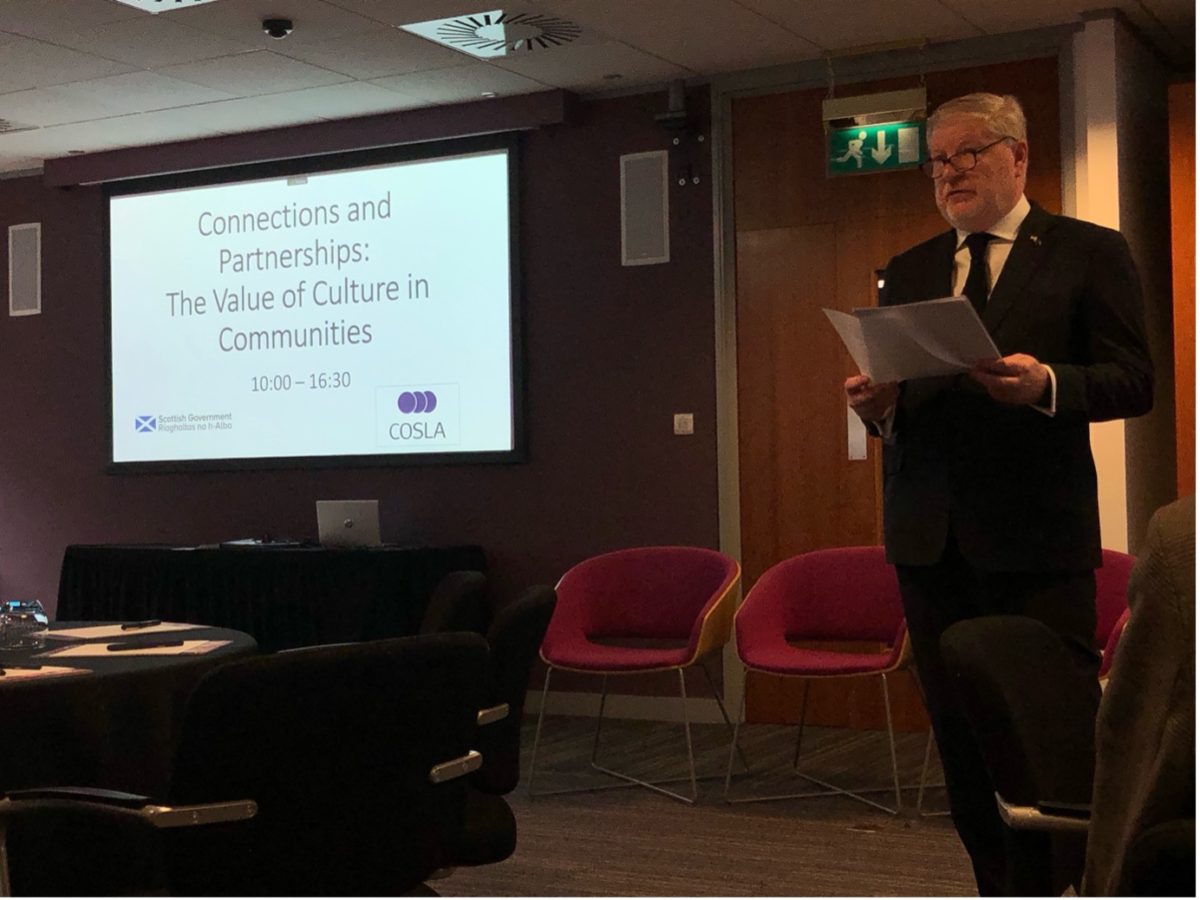
The Stove’s CEO, Matt Baker, recently participated in a summit between Scottish Government and COSLA (Convention of Scottish Local Authorities) called ‘Connections and Partnerships: The Value of Culture in Communities’.
The aim of the event was to encourage partnership working in culture, at local and national level, to support cultural activity at community level.
Exploring challenges, opportunities, and potential actions for change, the event was also attended by some cultural leaders to inform discussions.
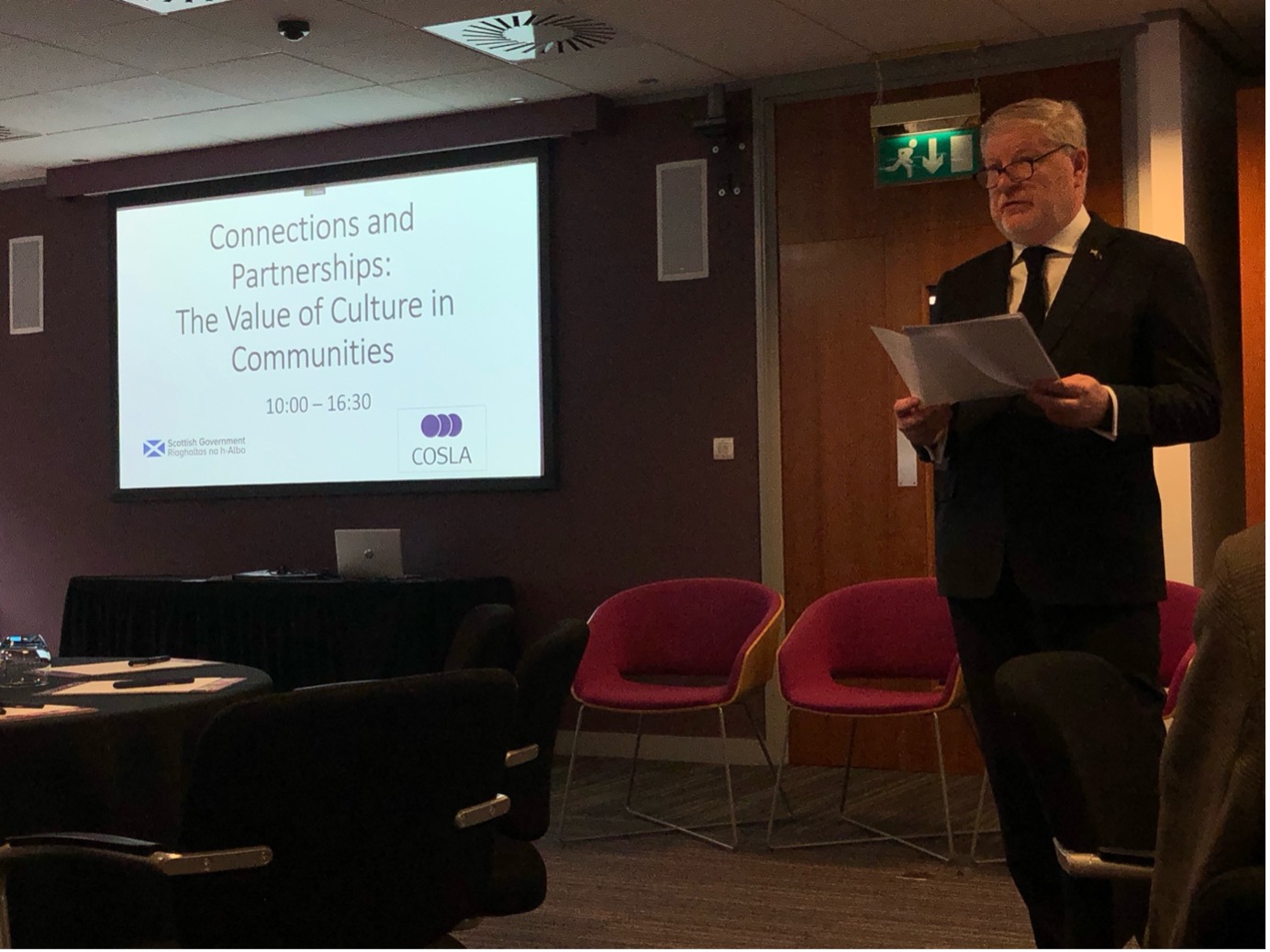
Angus Robertson MSP Cabinet Secretary for the Constitution, External Affairs and Culture introducing the event.
We caught up with Matt to find out what he was chatting about and how the idea of shining a spotlight on ‘Cultural Value’ can positively impact those working in the creative, social, environmental, and economic sectors at local level.
Matt’s talk followed a presentation by Inverclyde Council about their Culture Collective project 2021-23.
(Culture Collective is rightly celebrated in Scotland, and beyond, as an innovative new approach to connecting national and local cultural opportunity for communities).
‘Like Inverclyde, Dumfries and Galloway had a Culture Collective project which built capacity in community groups to work with creative practitioners to support their work in communities, particularly people and places that had been hard to reach previously.
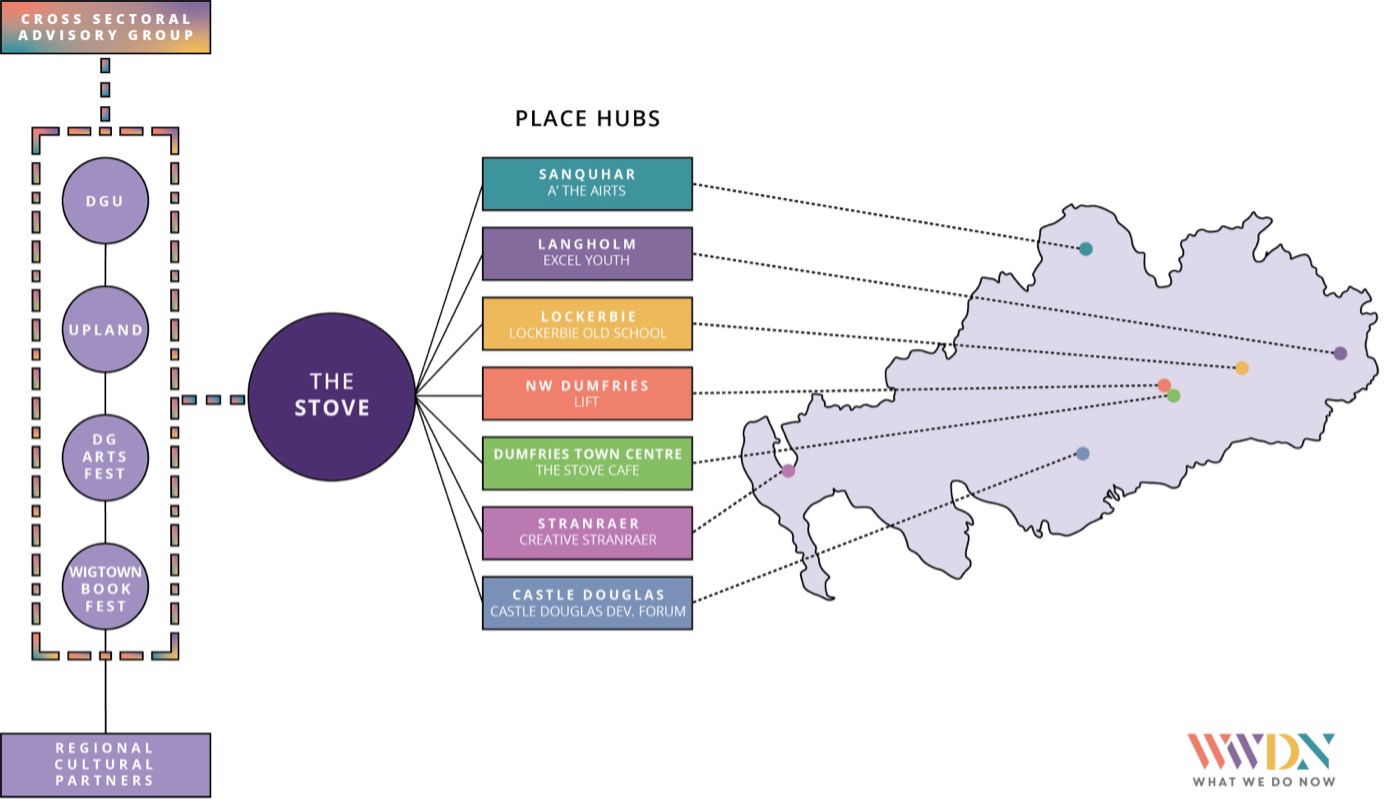
WWDN Culture Collective Project for Dumfries and Galloway
The legacy of this project for Dumfries and Galloway is the WWDN network which was formally launched earlier this year. This is a vision of our region working together to share resources, capacity and knowledge, using culture to benefit communities.
The principle is that community anchor groups are supported to build experience in working with creative practitioners.
Different communities work together on joint initiatives and all this activity will support a population of local creative freelancers and small cultural organisations.
Community groups and creative practitioners are members of WWDN and use the network to develop new projects and share best practice etc.’
Matt then turned to the practice of Creative Placemaking as an example of one working methodology which can support partnership working across different sectors at local level and draw new support for culture into communities.
‘This approach builds on 12 years of work by The Stove implementing creative placemaking practice in Dumfries town centre.
Our work centres on a simple idea; to use creativity as a tool to support community-led change. Change for individuals, for groups, for social enterprises and for places in their entirety through place planning and the like.
At The Stove we call this ‘Grow Your Own Culture’, a belief in the intrinsic value of participation in creativity, that people making their own culture is equally as important as consuming culture made by other people. This approach often leads to unexpected outcomes right across the spread of social, economic and environmental impact.
In Dumfries, creative projects with communities shaped a conversation across the town about its future, and critically how local people could be involved in making that future. To cut a very long story short, this led to a campaign to ‘buy back our high street’, which became the Midsteeple Quarter project.
Now, five high street buildings are in community ownership and are being developed by the community with over £10M inward investment to date.
What has also become clear through this work is that forming partnerships and bringing culture into collaboration, with other placemaking agencies, helps the creative sector to thrive. In the last year The Stove has cascaded partnership projects to local creative freelancers with 180 individual commissions worth over £200,000 in total.
This year, with South of Scotland Enterprise, The Stove released ‘A Creative Placemaking Approach’ which is published on a creative commons licence and free for anyone to use.
The document aims to lay out a methodology for creative placemaking so that the opportunities and impacts for partnership working across different sectors are clear, and local authorities, for example, feel confident to approach cultural partners about potential collaborations on placemaking projects in health, education, community development, innovation, regeneration and place planning’
Highlighting recent developments in Dumfries and Galloway with the Local Authority taking a creative placemaking approach to connecting larger strategies for economic development with communities on the ground through a place-based approach, Matt went on to talk about practical examples of this work in practice.
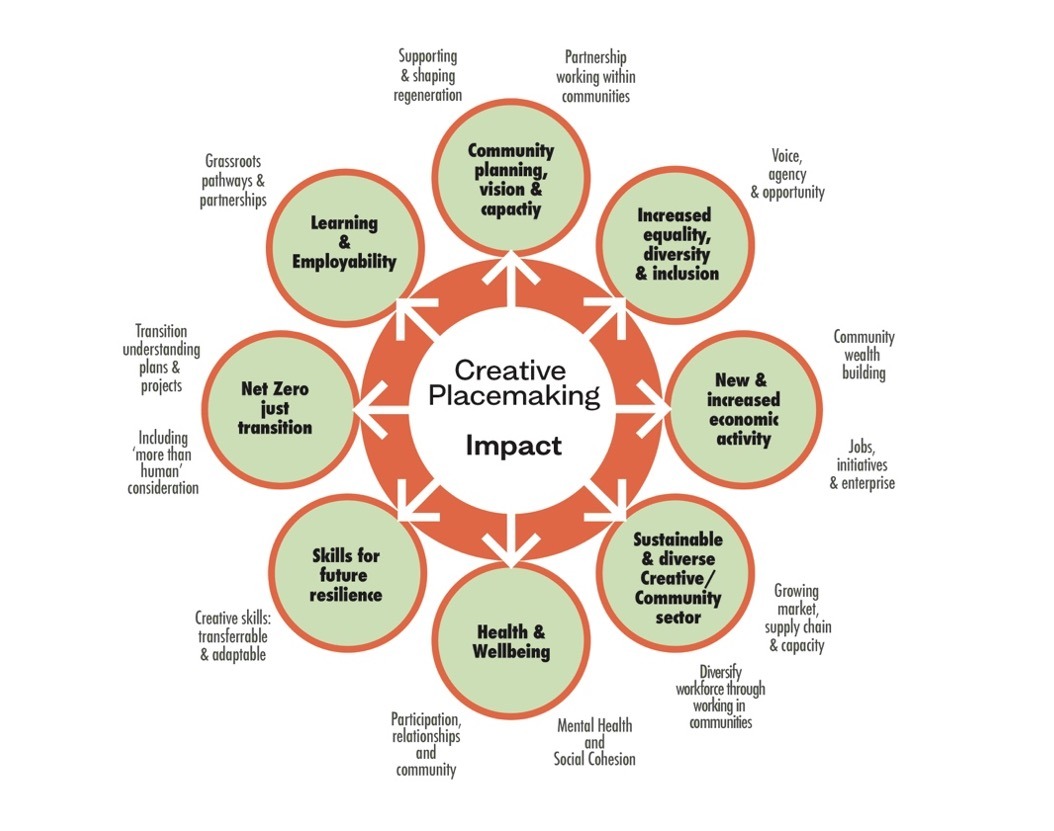
This diagram from the publication gives an idea of the spread of impacts from partnership working with the creative sector in the context of place.
Creative Placemaking Impact Diagram – From ‘A Creative Placemaking Approach 2024’
‘We believe this area of work has huge potential for connecting culture with other sectors through the shared agenda of placemaking for the benefit of both.
By way of example – the Economic Development department at Dumfries and Galloway Council is seeing the cultural sector as a vital bridge between strategic infrastructure planning and local communities.
With the advent of Levelling Up and Community Empowerment it is now critical to national funding that communities are directly involved in the design of capital projects – yet in D+G there is a wide gulf between economic development and the grassroots of communities.
In Stranraer, cultural organisations have been commissioned by the council to conduct creative community engagement which is giving less-heard communities a voice in the shaping and delivery of the capital development of the former harbour area and a former hotel on the High Street.
Discussions are also underway about using creative activities as catalyst to bring communities together to develop new ideas which feed into the economic development pipeline.
This work has proved so successful that six weeks ago, Dumfries and Galloway Council advertised, what we believe is, the UK’s first ‘Creative Placemaking Framework’ to enable the council to more easily procure the services of local arts organisations to undertake creative placemaking work.
Of course, there are challenges but it was very encouraging to see this area of work highlighted in the recent National Culture Strategy Action Plan (see S7) and I hope a greater understanding between COSLA and Scottish Government will play a significant part in delivering parts of that action plan.
Matt Baker is CEO and one of the founders of The Stove (est. 2011). The Stove was a progression of his practice as a public artist. Through his career Matt became increasingly concerned with the potential for creative process to empower communities. He sees The Stove as a long-term experiment in embedding a creative resource within a community – the work is a co-directed journey with local people and Matt remains completely absorbed and fascinated by where that journey is leading.
The Creative Spaces Project is looking for three new recruits to join its programme for 2024.
This is a paid opportunity for young creatives aged between 16 and 30, to join The Stove team on a part-time basis, for a fixed period of 10 months.
ABOUT THE ROLES
Fee: £672 per month (For each successful candidate)
Hours: Part-time, two days per week (14 hours)
Duration: 10 months, fixed term (Successful applicants will begin their contract on the week beginning 29th July, 2024.)
Contract Type: Freelance
Criteria: Applicants must be aged between 16-30 and have some form of creative practice, project or idea you would like to develop.
Deadline for applications: Monday 1st July at 12 noon
Based at The Stove Network in Dumfries, Creative Spaces works with young creatives from across the region providing a stepping stone into the arts and the world of being a creative freelancer.
Every year, Creative Spaces recruits three ‘Associate Artists’ t o complete a 10-month creative development programme where you will learn t o grow your creative interests, work with the Creative Spaces Team on various projects & events, and with guidance, will learn to develop your own personal project*.
Creative Spaces aims to build up and support Dumfries & Galloway’s creative scene. We d o this through putting o n events, hosting workshops, offering mentorships, and providing learning opportunities and networking connections to help people build their skills as creatives.
These opportunities aren’t just for people already working in the creative sector and you don’t have t o be an ‘established artist’, have a degree or previous experience to apply.
The Creative Spaces programme is designed to offer you the chance to explore the creative industries and try and find your place.
Interest and/or experience in t h e creative industries and community work Interest and / or experience in working with other people
Ability to self-manage your own workflow
PERSON SPECIFICATION
Adaptable
Engaging
Creative
COMMITMENTS
Time commitments will include a combination of regular hours (to be determined by team availability) and some flexible working across projects (evenings, weekend work).
You’ll be required to attend weekly meetings and take part in project development and delivery of work across our programme:
1 x Fixed day per week based in The Stove (either on Tuesday or Thursday)
1x Flexible day per week (either working from home or in The Stove)
Weekly Creative Spaces meetings with Creative Spaces Producer Weekly Projects meeting (With the full StoveTeam)
HOW TO APPLY
Deadline for applications: Monday 1st July at 12 noon
Please submit your application by email to [email protected] (max file size of 10MB) with the heading Creative Spaces – Associate
Feel free to be creative with your application. We’ll accept any of the following formats, but please remember to let us know:
Why do you think joining the Creative Spaces programme will benefit you?
Why do you think now is the right time to apply to this programme?
What do you hope to achieve?
Please include brief details surrounding a project you would like to pursue as part of Creative Spaces (this could be a series of workshops, an event or any other creative output).*
*Please note that this idea is just so we can understand the kind of areas you may be interested in and any projects you wish to pursue. This is not a final idea that you have to take forward.
APPLICATION FORMATS:
We’ll accept any of the following formats:
Covering Letter (no more than 500 words)
Video (no more than 3 mins)
Image pack or portfolio (10MB or less)
Voice note
Just make sure that you include a CV or text sheet with your name, contact details and a few examples of recent work (this could be images, videos or write-ups).
It’s important that our people reflect and represent the diversity of the communities and audiences we serve. We welcome and value difference, so when we say we’re for everyone, we want everyone to be welcome in our teams too. Wherever you’re from, and whatever your background, we want to hear from you.
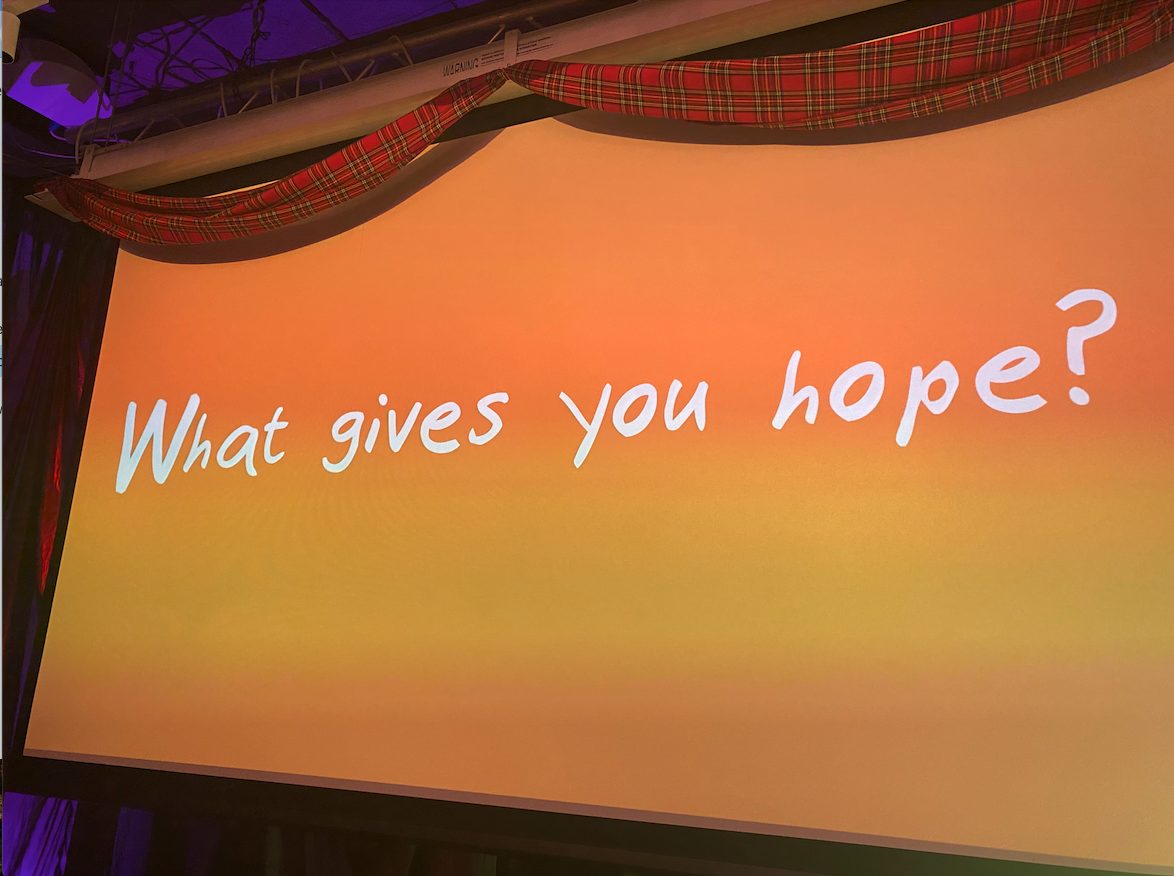
What Gives You Hope? From the Gaither Inn – Image Credit: Erin Aitchison
Artistic Director, Martin O’Neill has spent almost a decade creating, developing, collaborating on and championing some of the brightest creative ideas to come out of our town through his work with The Stove. All of which have been co-created with for and by our local people. However, at a time where so much uncertainty looms over all of us, not just in the creative sector, we challenged Martin to reflect on the last year, and asked him; “What gives you hope?“
Homemade Hope
By Martin O’Neill – Artistic Director
The last few years… they haven’t exactly been a fairground, have they?
Each New Year, the promise of better unfurls like a golden ticket. Although initially adorned with fine intents, clear plans, and a bright outlook… it gradually reveals itself to be more akin to Glasgow’s Willy Wonka experience – complete with gloomy Oompa Loompas, bargain bucket backdrops, and a quarter cup of lemonade. Happy New Year folks!
So it’s forgivable, when asked ‘what gives you hope?’, to re-coil and grimace given the last few years.
Hope is not often a word we hear in the news. Its closest relative ‘resilience’ is banded around in party political slogans; spun and doctored till they’ve lost much of whatever profundity they were meant to stand for. ‘Resilience’ now appears before us akin to a Frankenstein’s monster. Its made up of all the different parts, and looks about right – but there’s no soul about it. The word has been so chewed up by billionaires and politicians it’s been rendered tasteless. But this isn’t a blog about billionaires. I’ll save that one for another day.
With that said in many ways, there’s hope for… hope.
But hope encompasses more than its definition suggests; ‘a feeling of expectation and desire for a particular thing to happen.’
Across various scientific disciplines worldwide, entire factions have dedicated to study hope. From neurology to social science and economics, the study of this hard-to-put-into-words feeling is uncovering stuff that may well determine the future of our world and us in it. Hope’s significance extends from longevity and survival to happiness and humanitarianism. It’s becoming a key factor in determining an individual’s happiness and resilience, making waves in our understanding of mental illness. Moreover, its impact on fostering progressive and healthy communities is increasingly recognised.
So I’d like to take you on a little voyage through hope as I see it – the places where it thrives and the people that nourish from it. From Stove-led projects to the quiet things we’re up to no one really hears about, and to others in D&G, working their way day-by-day to what some might call utopia ‘Dumfrutopia’?!
Homemade Mutant Hope Machines
What a title!
In February, during the Stove’s annual general meeting, we welcomed researcher, artist, and all round ruddy guid guy ‘Dr. Duckie‘ (also known as Dr. Ben Walters) to discuss his PhD research. Titled ‘Homemade Mutant Hope Machines’, Ben’s research was completed with the queer performance collective ‘Duckie‘ from Vauxhall, London.
Duckie is a pioneering LGBTQ club collective born in Vauxhall, London 25 years ago. Known for its eclectic mix of music, artful stage performances, and inclusive atmosphere, Duckie has evolved from late-night revelry to a respected arts organisation. Their portfolio includes award-winning shows like ‘C’est Duckie!’, immersive experiences like Lullaby and The Class Club, and a vibrant LGBTQ history program. Beyond their core community, Duckie extends its reach with socially engaged projects targeting diverse audiences, supported by Arts Council and National Lottery funding. With a dedicated team and a host of collaborators, Duckie hosts over 130 events and workshops annually, always aiming to blend fun with creativity.
‘From 2014-2018, Ben did a PhD about Duckie’s work and coined the concept Homemade Mutant Hope Machines – a way of describing how people without much clout can start to build better worlds on their own terms.’
“Homegrown Mutant Hope Machines” broadly describes emergent, autonomous, and adaptive forms and processes that consistently cultivate hope for a better world, especially for marginalised populations. This title encompasses community groups, art projects, and organisations dedicated to enabling and empowering people. This is successfully done trough a values-driven approach centred on possibility, hope, and utopia.
In my own little world, hope took hold as the characteristic of not only our past, present and future projects here at the Stove, both now and then and yet to come, but that of nearly countless other groups and people across D&G.
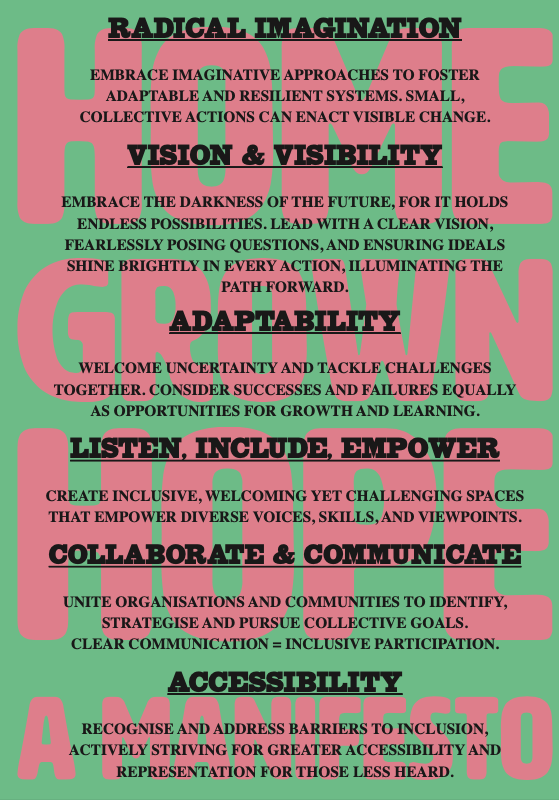
A Manifesto of Homegrown Hope
In January, we launched the inaugural Gaither Inn event. It marked the beginning of a ongoing, dynamic series of gatherings designed to kick-start new ideas and possibilities for our town. The Gaither Inn also featured a mair than plentiful spread of haggis, neeps and tatties in honour of the Bard. With each course of food, a question accompanied, dividing the evening into three chapters. These were:
What gives you hope?
What are the ingredients of a space to nurture hope?
How do we achieve this together?
Invited to speak with their neighbours, everyone discussed these questions and worked towards creating a ‘Manifesto of Homegrown Hope’. Notes upon notes of handwriting from our ‘punters in residence’, (that would rival that of a chain-smoking Doctor in the 1970’s), combined with a sprinkling of poetic license, resulted in the following manifesto…
The Manifesto of Homegrown Hope
Of all the captivating headlines here, one stood out to me the most, ‘Vision & Visibility’.
History reminds us that significant change seldom occurs in obscurity. It is not typically driven by the majority or the zeitgeist of the masses, but rather by the vision of a determined few. So the notion of ‘embracing darkness’ to light the way forward is precisely where creativity, coupled with community, ought to exist. This is where the adaptive and autonomous nature of hope machines thrives: not in prescribing bold and concrete answers for the future, but in posing questions and consistently caring in their efforts toward an as-yet unwritten future.
Questions open the door to the future and are more powerful than answers in that they demand engagement. Engagement in the right questions is what creates accountability. How we frame the questions is decisive. They need to be ambiguous, personal, and stressful.
Peter Block
With that in mind, let me introduce you to a selection of Homemade Mutant Hope Machines. Some we’ve directly supported, others we’ve stood beside as allies, and a few have even sparked our own inspiration.
While there are countless inspiring projects happening across D&G, I’ll focus on those we’ve recently engaged with. Here is a glimpse into the ongoing work and the individuals driving us onward.
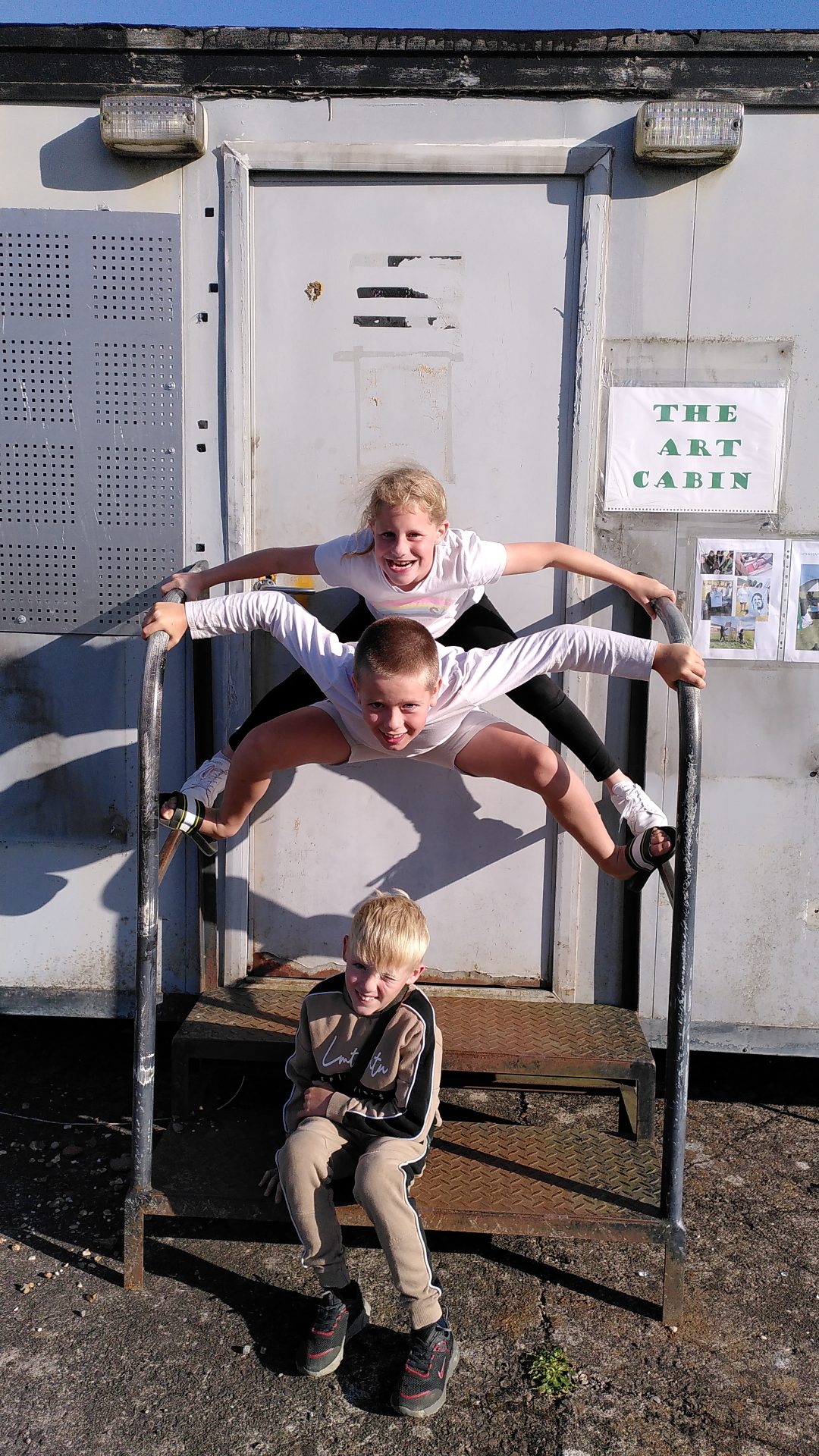
The Art Cabin: LIFT
Image by Kirstin McEwanImage by Andy Brook
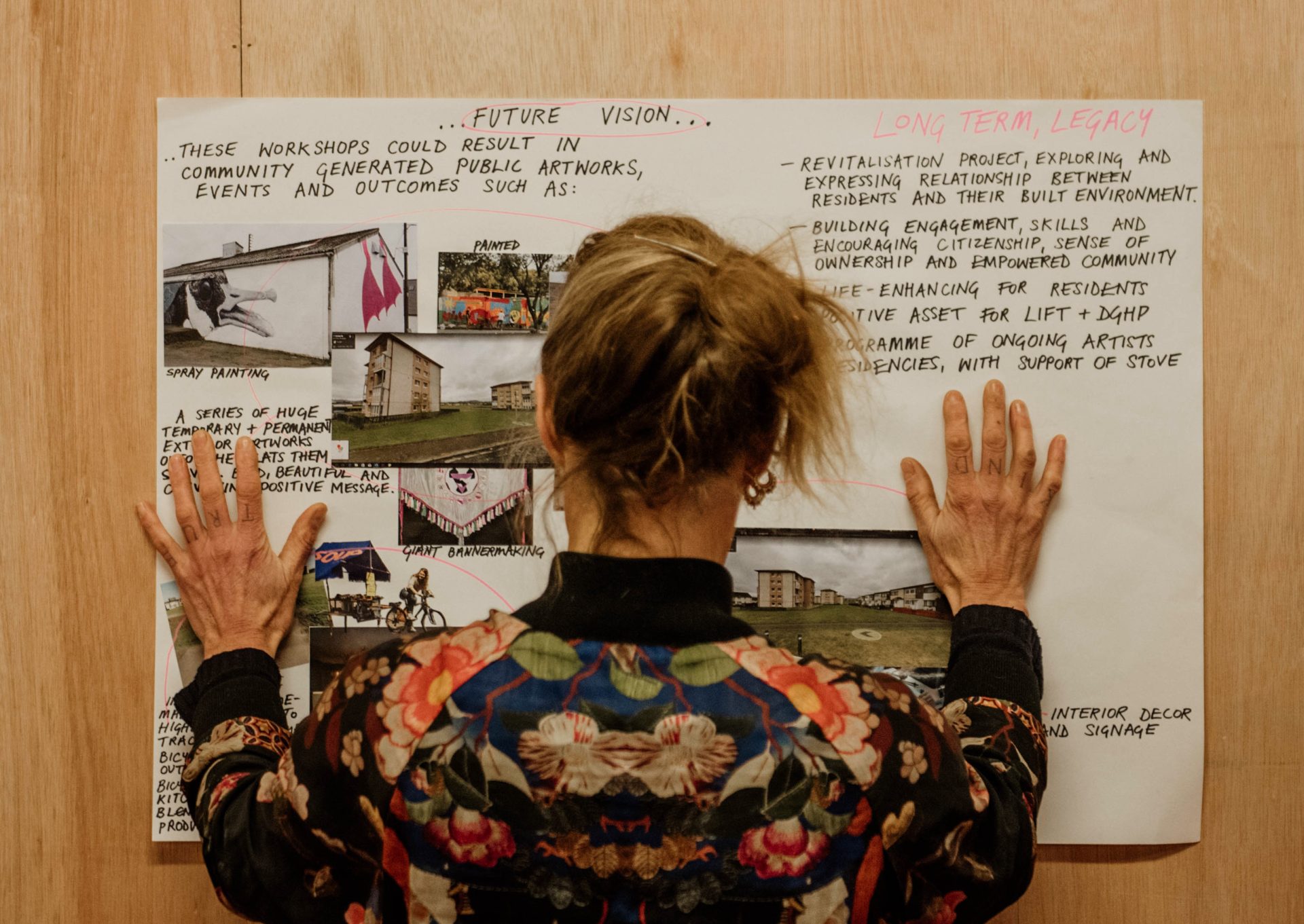
Proposed by artists Alice Francis and Rosie Giblin, the Art Cabin is on the verge of becoming a reality. The project began back in 2021 during the initial phase of the What We Do Now project. Nestled in Dunlop Road, it will serve as a communal space for collective creativity. Above all, the word that epitomises the Art Cabin is “persistence.”
Persistence in the belief that it is the right thing to do. In chasing that one guy who does that one thing. Persistence in getting that one thing done so the other seven hundred things move to get the cabin open.
The Stove’s Operations Director, Graham Rooney, led the charge, and made it happen. The Art Cabin will be launching later in the year thanks to Creative Scotland funding. Achieved in part by the remarkable Morgan Love, a Creative Spaces alumni and LIFT team member.
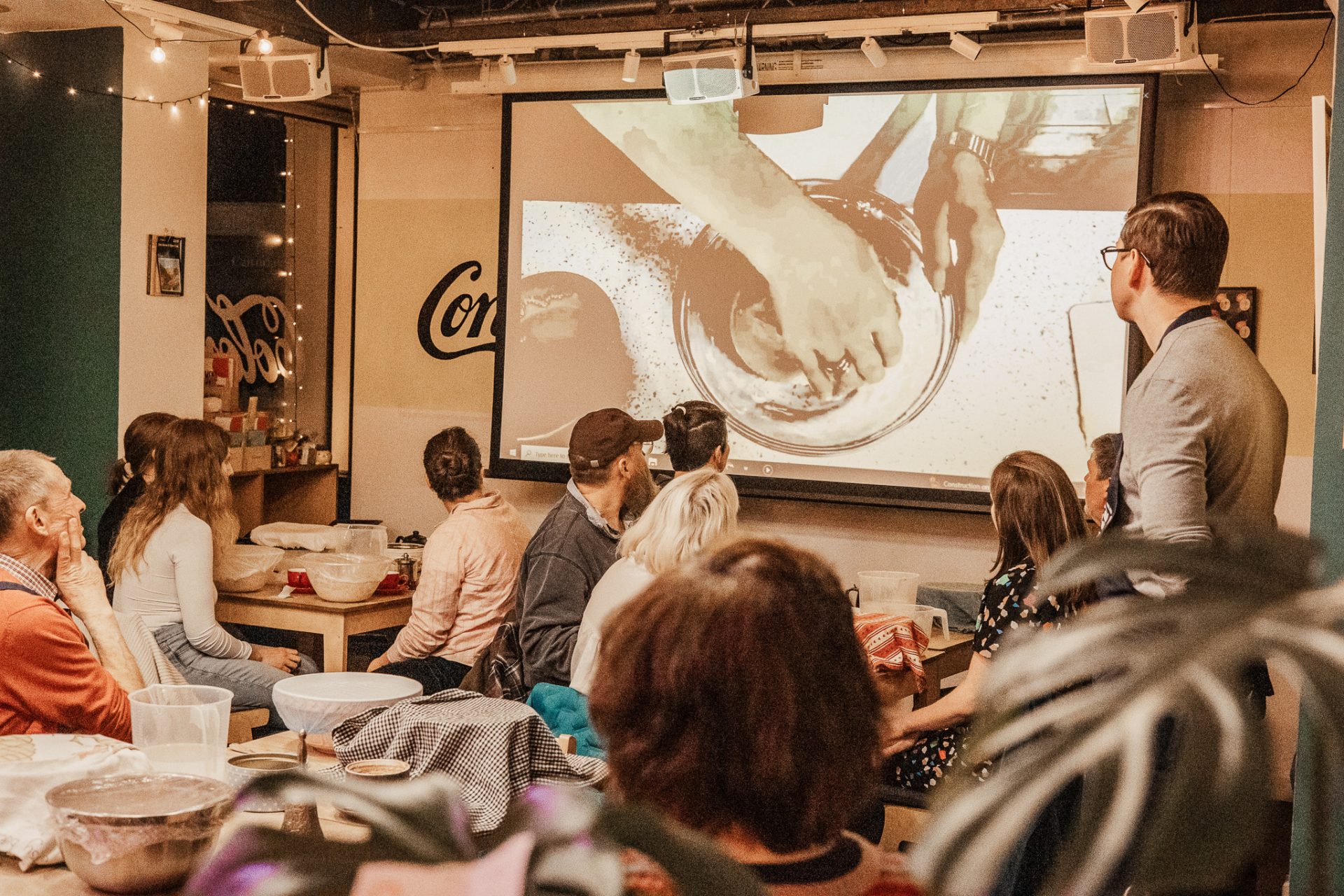
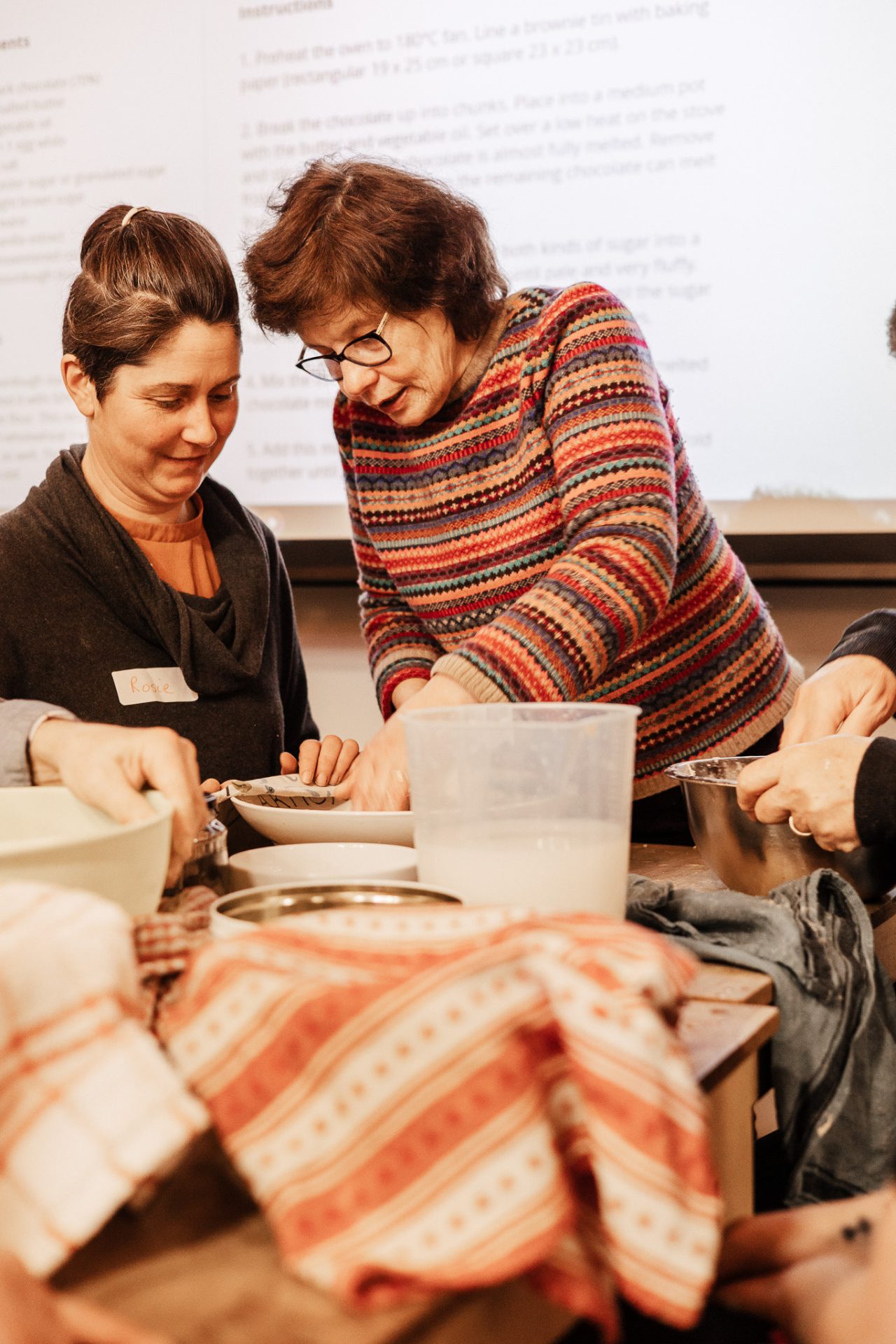
Liz, a retired Macmillan nurse turned community pioneer, has spearheaded Doughlicious for several years. She has fostered a sense of camaraderie through the shared joy of making delicious sourdough together.
Her dedication extends to Summerhill. Liz volunteers her time to offer free, locally sourced, organic, homemade sourdough bread to those in need. She has successfully united the community in promoting homegrown, locally made, healthy alternatives to store-bought bread.
She is a truly remarkable individual who inspires us all every day.
Maya Rose Edwards: ‘Harbour’ Stranraer
Rarely does an artist, especially one so young, embody the principles of socially engaged and community arts as effectively as Maya Rose Edwards.
Throughout their tenure as the Creative Stranraer Waterfront Project artist, Maya’s project ‘Harbour’ has forged connections with the townsfolk in a manner that even the most outgoing individuals would find challenging.
Referring to their process as “making friends” rather than retreating into solitary research and introspection, as many artists do, speaks volumes about Maya’s ethos, which firmly believes in the transformative power of community engagement.
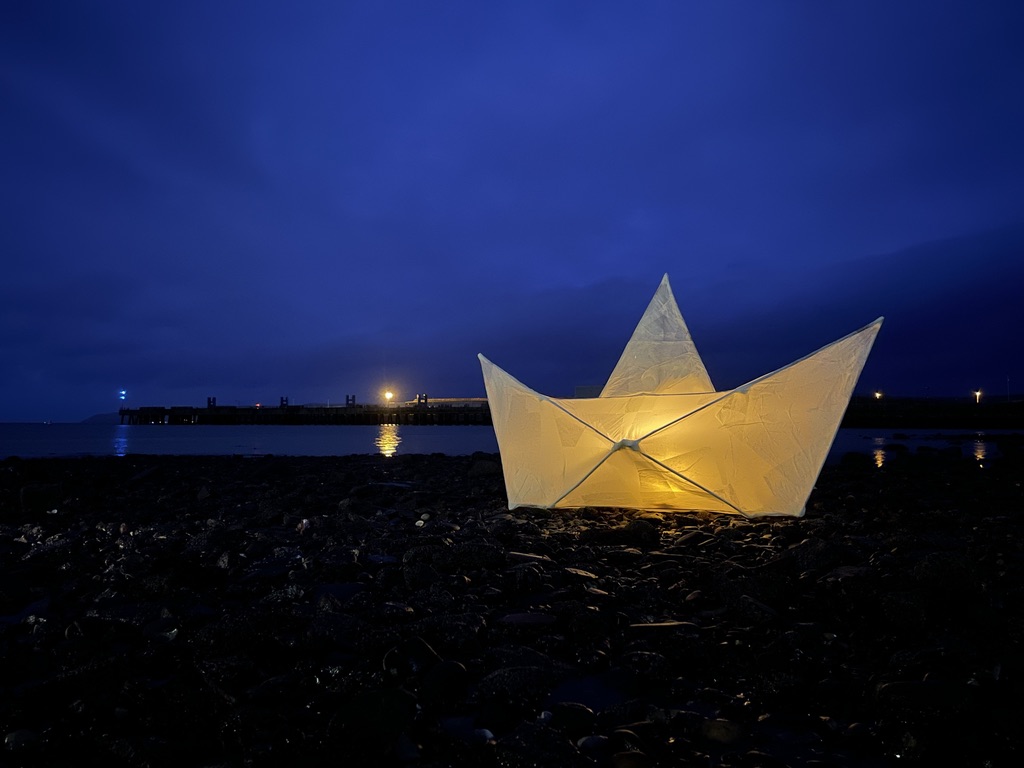
In Stranraer, Maya’s mission has been to foster dialogue, connection, and a shared vision for the town’s waterfront, rooted in its heritage and future aspirations. The culmination of this endeavour was a community festival, ‘Raise The Sails’, that celebrated possibility and imagination, marked by the symbolic act of “raising the sails” for a rejuvenated Stranraer.
Summerhill Community Centre: Anne Marie
Image by DEAR FRIEND FILMS
If you’ve not heard of Anne Marie then where have you been?! I’ve only had the pleasure of working with Anne Marie recently through our Creative Caerlaverock project. The project worked with the young team at Summerhill to engagee, promote creativity and excitement about the history and future of Caerlaverock Castle as a site of historical significance and burgeoning creative potential. If you haven’t yet seen the ‘Siege of Summerhill’ and the accompanying documentary capturing the work led by Stovie Sal Cuddihy then check it out, if nothing else, it’s a good laugh.
In even a short visit, it’s evident Anne Marie has managed to nurture a caring, supportive and connected space that I feel every community deserves. Or rather, if every community or neighbourhood had an Anne Marie, the future would be good in good hands.
Off The Margin
Images by Kirstin McEwan
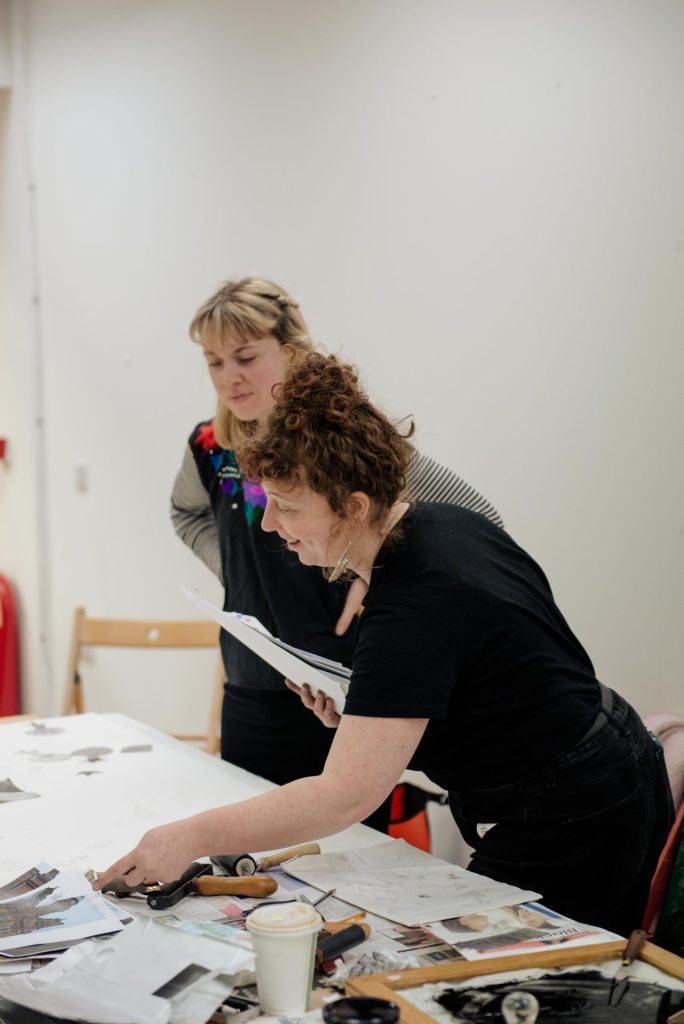
One of our most recent projects was a deep-dive into the world of grassroots press and radical print. Over the weekend we were joined by journalists, print-makers and artists both local and national – engaging the town in conversations and workshops from investigative journalism with Karin Goodwin of The Ferret to podcasting, print-making and comic books.
What felt remarkably clear was the appetite and desire for Dumfries to re-connect with its vibrant printing heritage and sewed the seeds for exciting future projects in community news and print-based practices.
The hope here lies in the re-establishing of Dumfries as a place where opinion, expression, creativity and colour could once again return to the written and printed word – and away from the divisive and exclusionary worlds of social media. Watch this space.
Creative Spaces
Images by Owen Davies
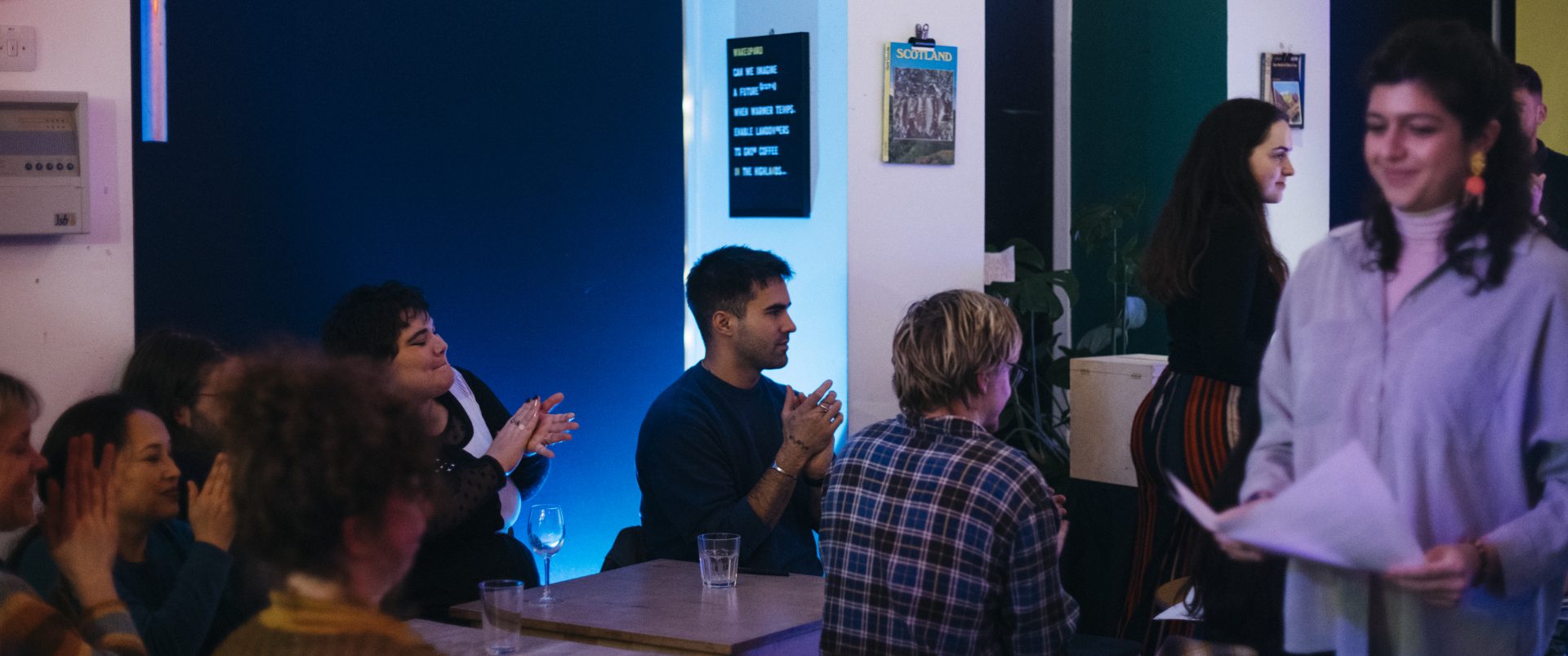
Nothing embodies the essence of a “Homegrown Mutant Hope Machine” quite like Creative Spaces, especially its recent Showcase. Featuring a diverse array of local young creatives and entrepreneurs from across D&G, it was an evening that showcased the remarkable talent and potential of the region’s future leaders.
This initiative, nurtured by The Stove, has flourished over the past decade, evolving from Young Stove to Blueprint100. The work being done, led by the youth of D&G, is truly remarkable – from community projects aiding those in need to vibrant queer activism and artistry.
These young innovators ensure inclusivity in shaping the region’s future, a valuable lesson for us all. Despite the challenges and prevailing narratives of decline often associated with our aging population, these young creatives embrace a forward-thinking mindset. They are inspired by the possibilities of what lies ahead and are actively forging paths forward, even in the face of darkness.
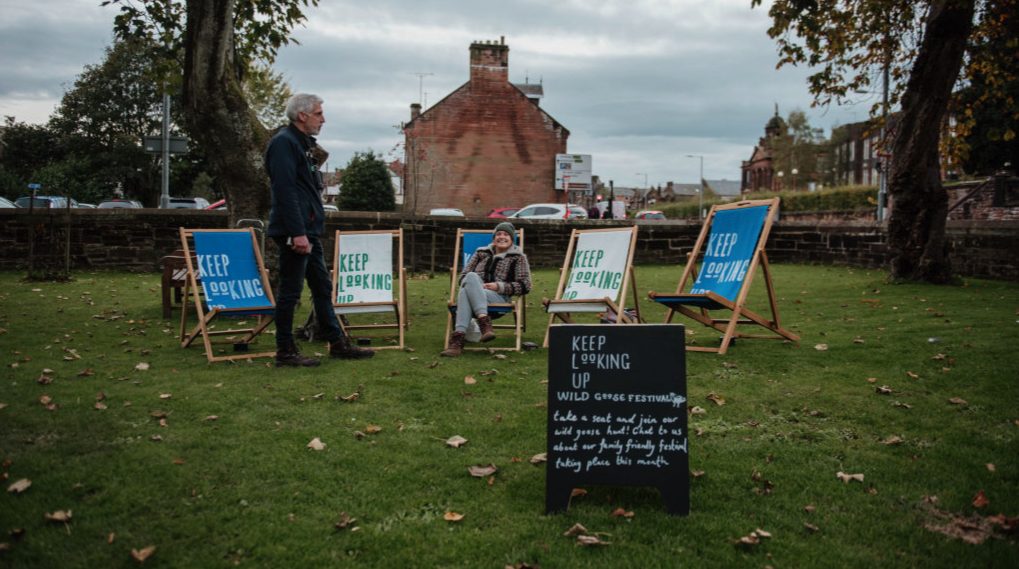
Wild Goose Festival – the Partnership
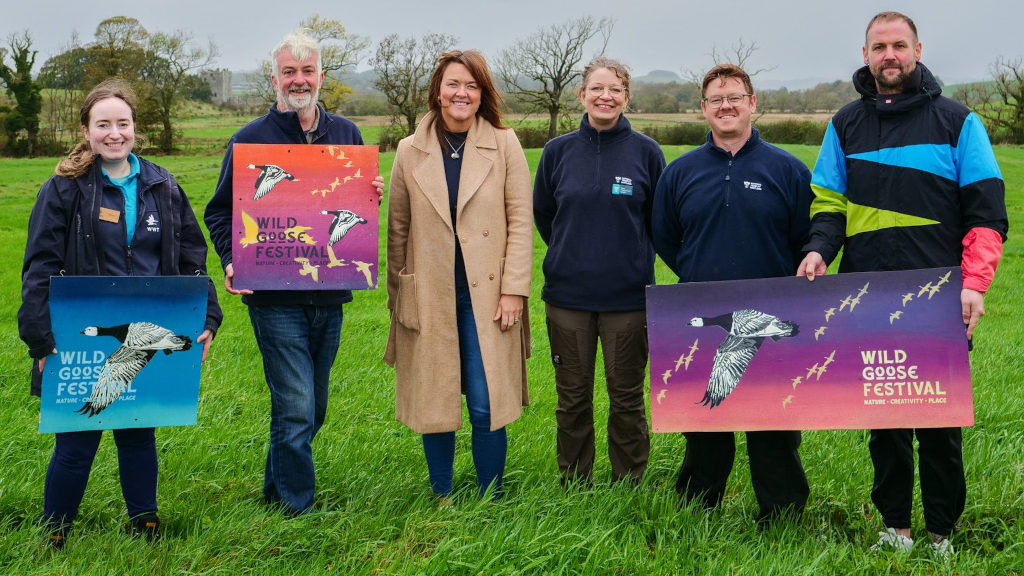
The Wild Goose Festival is not just about the event itself, but the incredible individuals and organisations behind it. Comprising 24 partners spanning the arts, nature, community, tourism, and wildlife sectors, it serves as a beacon of hope.
In Scotland, there’s often a tendency for organisations to operate in silos, focused solely on their own needs due to financial pressures, policy shifts, and societal challenges stemming from years of government disinvestment. However, the partners of the Wild Goose Festival have committed to collaboration, working together to create a sustainable and vibrant event.
By celebrating our natural ecology and redefining the traditional festival model with a forward-thinking and hopeful perspective, these partners are paving the way for a truly unique festival experience. One where creativity, nature, and community converge to address the pressing issues of our time and inspire positive change.
Oor Hoose
Photos from the Oor Hoose Facebook page
Nothing embodies the spirit of “just do it” quite like Oor Hoose. Founded by Dumfries’ own Madame Jo and Devine Tension, Oor Hoose has provided vital support to young LGBTQ+ creatives and performers, nurturing their talents and empowering them to showcase their skills in the heart of the town centre.
As a gay Doonhamer growing up in the town, if you had told me such a space was going to exist, I would have called you a fantasist. But no, it’s very much a real thing – and it’s truly amazing to see. Now established as a community interest company, Oor Hoose has secured funding from the Hollywood Trust to offer workshops and experiences for young queer artists in D&G. With a Showcase scheduled for May at the Stove Cafe, I’m eager to witness the incredible talents of this remarkable crew.
We use cookies to improve your experience on our website, analyse traffic, and personalise content. By using our site, you consent to the use of cookies. Please read our privacy policy for more information.
Cookie Preferences
Manage your cookie preferences below:
Essential cookies enable basic functions and are necessary for the proper function of the website.
Name
Description
Duration
Cookie Preferences
This cookie is used to store the user's cookie consent preferences.
30 days
Statistics cookies collect information anonymously. This information helps us understand how visitors use our website.
Google Analytics is a powerful tool that tracks and analyzes website traffic for informed marketing decisions.
Contains information related to marketing campaigns of the user. These are shared with Google AdWords / Google Ads when the Google Ads and Google Analytics accounts are linked together.
90 days
__utmx
Used to determine whether a user is included in an A / B or Multivariate test.
18 months
_gali
Used by Google Analytics to determine which links on a page are being clicked
30 seconds
_ga_
ID used to identify users
2 years
__utma
Used to distinguish users.
Persistent
__utmb
Used to determine new sessions/visits.
30 minutes
__utmc
Used to determine if the user is in a new session/visit.
Session
__utmt
Used to throttle request rate.
10 minutes
__utmv
Used to store visitor-level custom variable data.
2 years
__utmz
Stores the traffic source or campaign that explains how the user reached your site.
6 months
_ga
Used to distinguish users.
2 years
_gat
Used to throttle request rate.
1 minute
_gid
Used to distinguish users.
24 hours
Clarity is a web analytics service that tracks and reports website traffic.