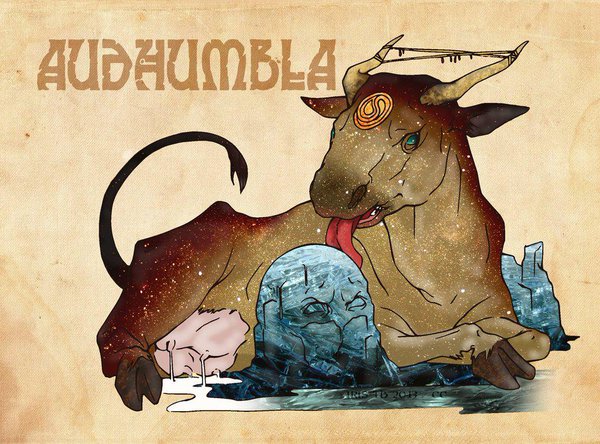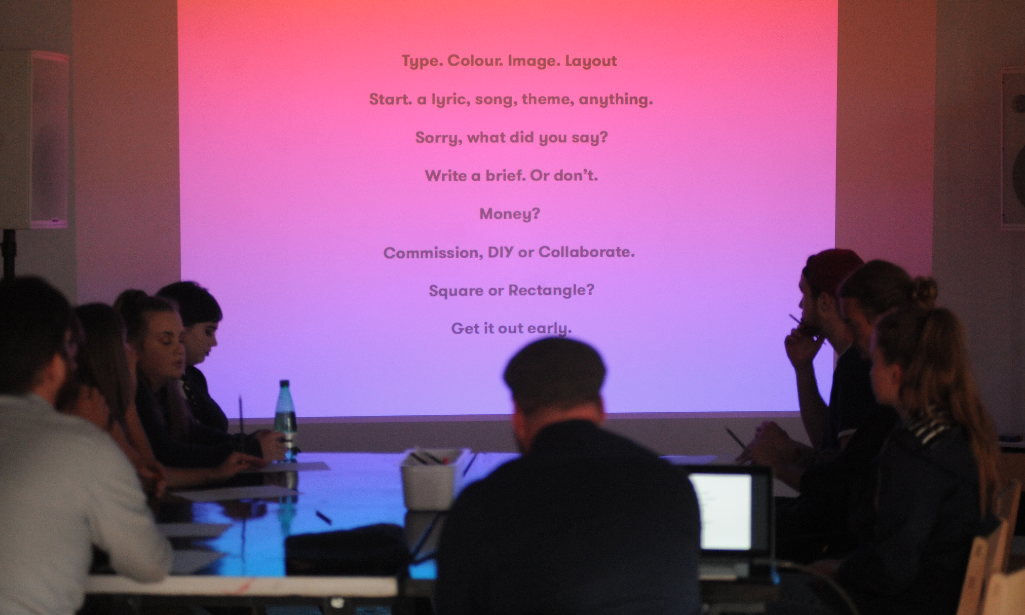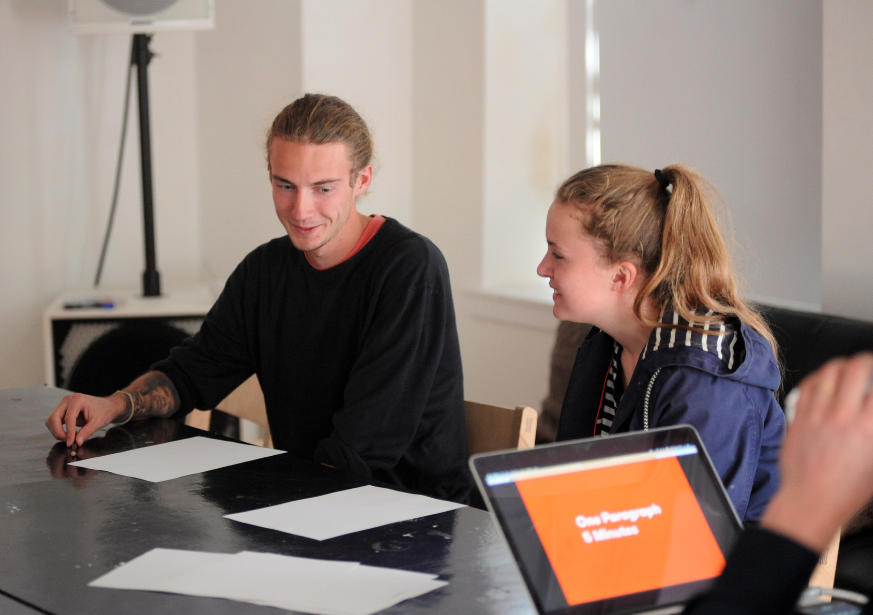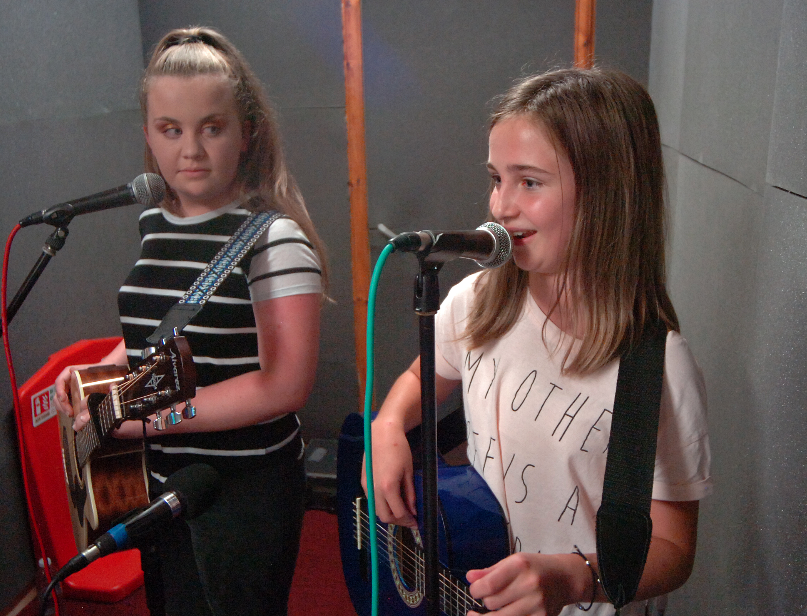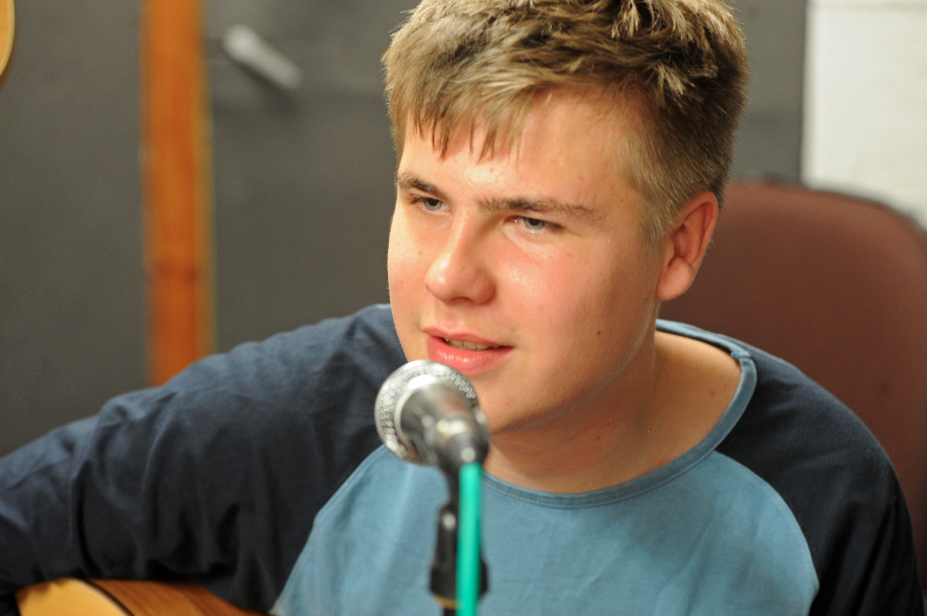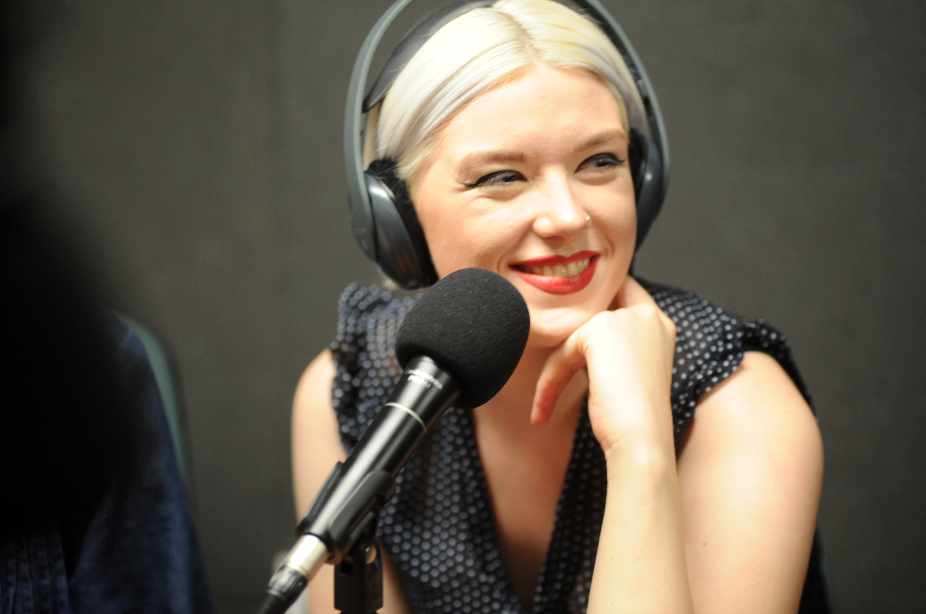
In an effort to provide young musicians the opportunity to write, record, and release their own tracks; Blueprint100, in association with D&G Council and DGU, created the Song Factory. Running over the course of two months, participants were taken through various aspects of the music industry from songwriting to graphic advertising. Workshops ran every Wednesday from the 14th of a June to the 5th of July, with time to record until the 2nd of August when the final workshop was held.
During these workshops those involved were able to work with poet Hugh McMillan; singer-songwriter Jamie McClennan; graphic designer Sam Sparrow; and producer and owner of Lovers Lane Studios Grant Christian Henderson. They worked in groups to create 3 songs overall, paying ample attention to both music and lyrics, and then – after a tour of the studios – were funded to record these songs.
The final workshop focused on publicising your music, so as well as being taken through some basic graphic design participants were talked through an interview in preparation for a slot on the Thursday Night Showcase on Alive radio the following night. Here they talked about how they found the course and either played their track or performed their song live. All recorded tracks will be regularly featured on the show from this point onward.
The response to Song Factory has been truly touching, with the involved Blueprint members receiving messages of thanks from many of those involved, and the songs created will be worthy additions to Dumfries and Galloway’s ever-growing music scene.
All photographs credited to Kirstin McEwan Photography.
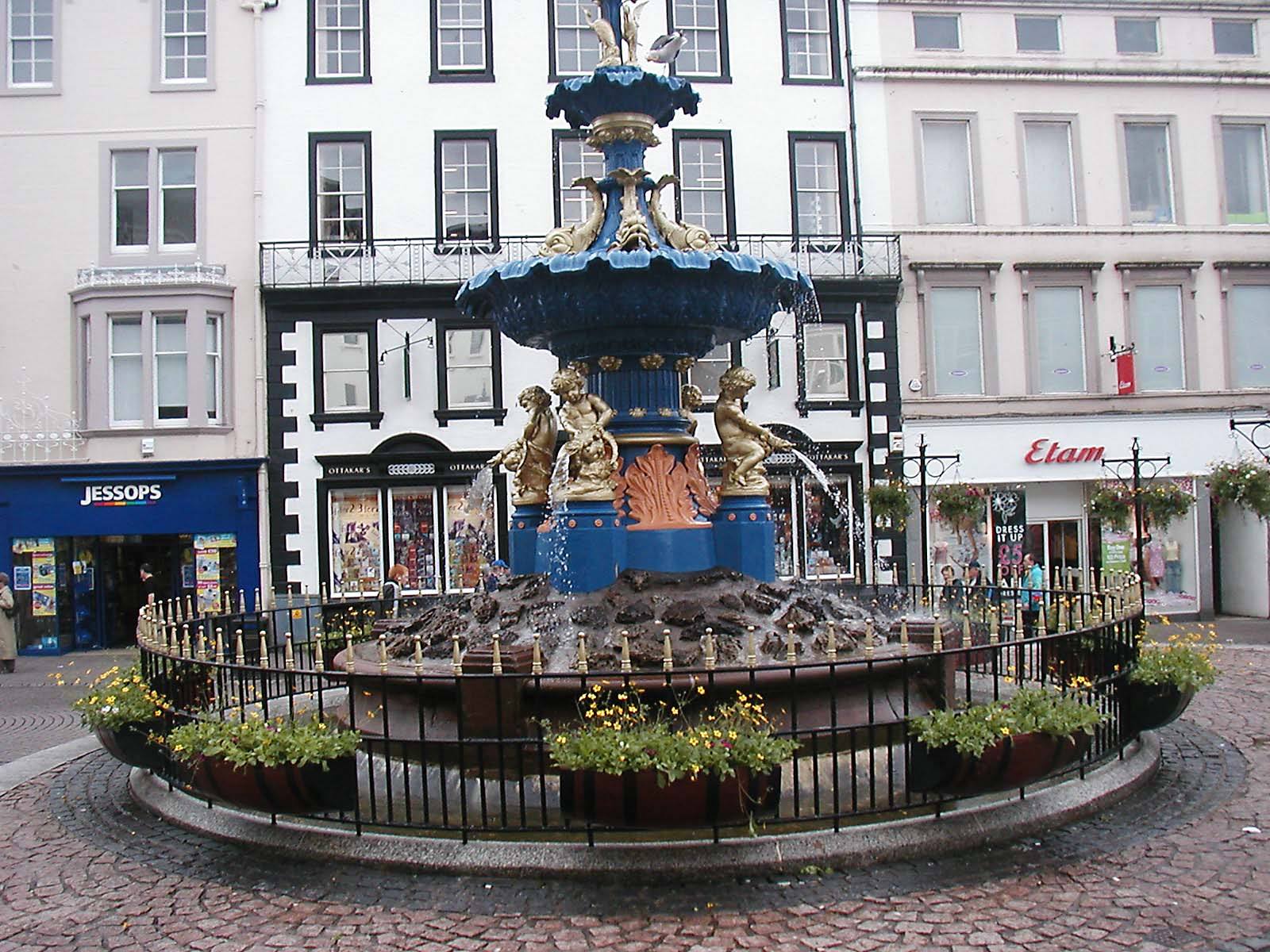
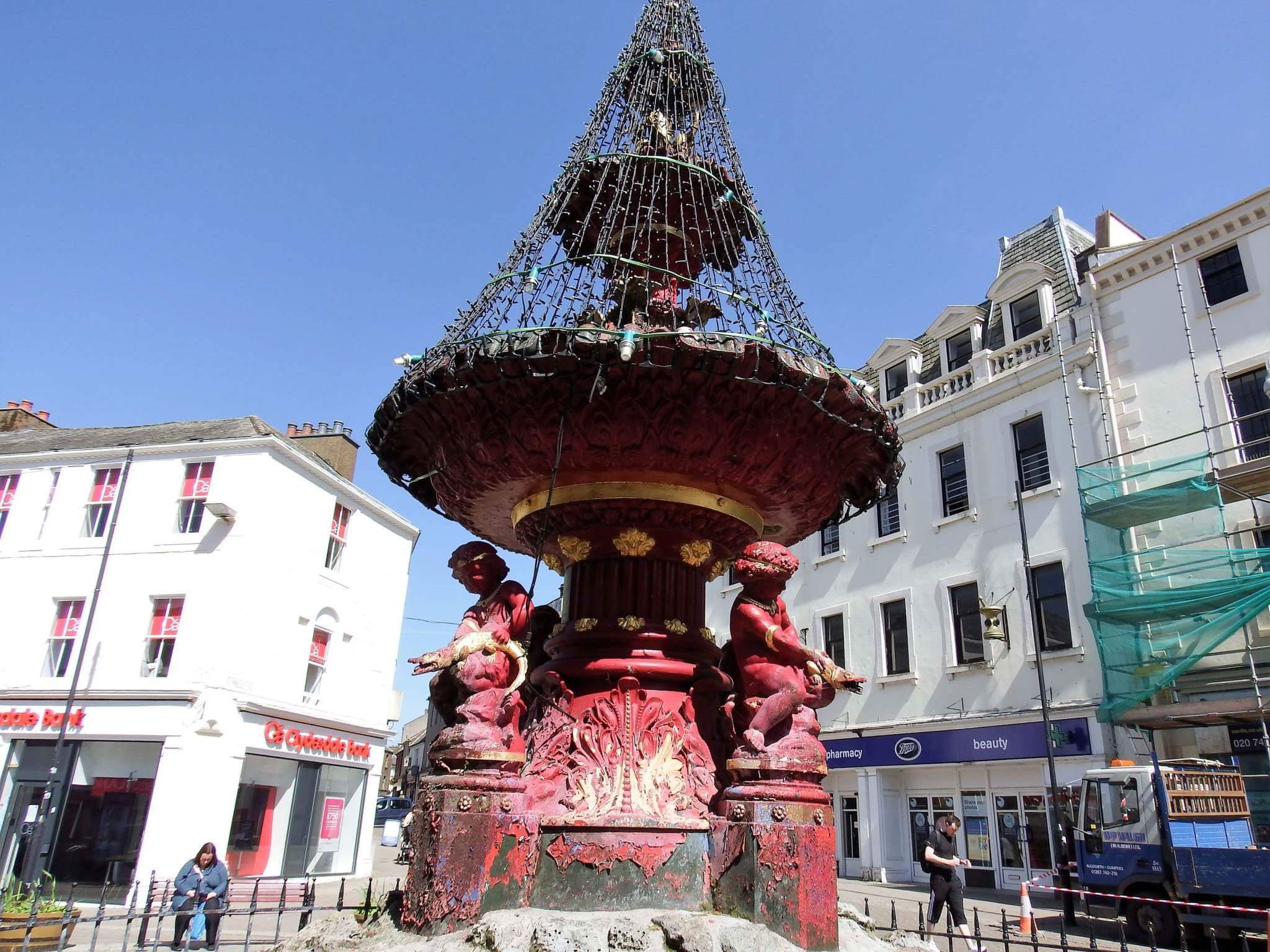
Kirsten McClure Rowe has recently been in touch with the Stove as she has recently been researching into the history of Dumfries’ fountain, with the aim of hosting a crowdfunding campaign to restore the fountain to it’s former glory. Her proposal includes stripping back the layers of old peeling paint and professionally restoring it to it’s original colours which were gold and bronze with cactus painted to appear real.
The following is some of Kirsten’s research into the history, and potential future for the Dumfries Fountain:
‘On the 5th of December 1882, Provost Lennox unveiled the fountain which stands on Dumfries High Street. It was made by the Sun Foundry, Alloa and is one of only two models of its type known anywhere in the world. The fountain commemorates the supply of public drinking water to the town from nearby Lochrutton.
The first pipe of the waterworks was laid on 16th January 1851 after many years of wrangling by various committees in Dumfries and Maxwelltown. Many felt that the pipeline wasn’t necessary and that the half a dozen or so seepage wells, which supplied some of the water and the bulk of the supply taken by the “burn drawers” in their dirty wheeled barrels from just below the main sewerage outlet in the Nith and sold at a penny a bucket, were sufficient.
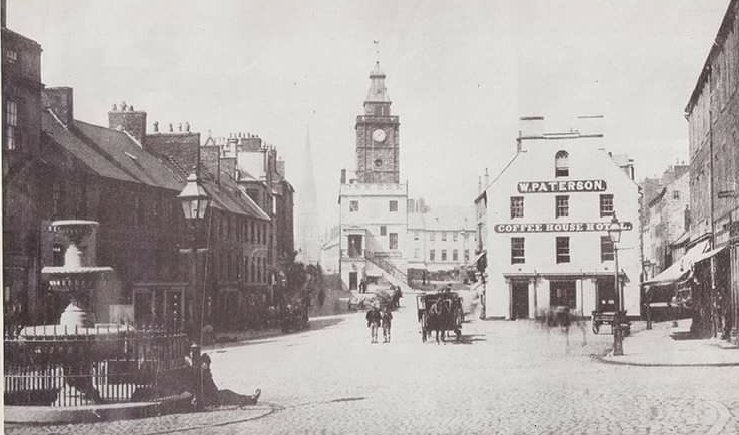
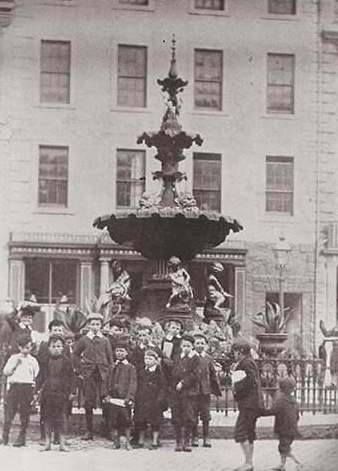
Original Fountain circa 1870
In September 1832, Cholera struck Dumfries. A total of 841 people contracted the disease and 421 died within Dumfries, with a further 237 becoming ill in Maxwelltown of which 127 died. A mass grave at St Michaels churchyard bears a memorial to 420 souls. Unofficial figures state that as many as 700 coffins were produced in the 3-month period of epidemic which ended on 27th November 1832.
“In 1848 cholera struck again. The infant Scottish Board of Health, with little real power, sent Dr John Sutherland from Glasgow, a man of strong personality. He found corpses lying in the streets and no action being taken at all. He got a medical board organised, a house cleansing programme under way and immediately tracked the cause to the water supply and cleared up the epidemic, but not before 431 people had died out of 814 cases.”
Colours of the Fountain in 2004
As early as 1765 there had been proposals to introduce a clean gravitation water supply into the town, however it took until 10th May 1850 for a Committee of the House to give a unanimous verdict in favour of the promoters. As it was chiefly working-class areas that suffered in the first cholera epidemic, it was suggested that intemperance and lack of religious faith had led to this divine punishment of the poor. It was only after the middle-class residents of Dumfries and Maxwelltown began to fall ill, that any real action was taken.
A newspaper article from 22nd October 1851 reports the “Record of Public Introduction of Water to Sister Burghs of Dumfries and Maxwelltown” “This boon has been secured after a severe and protracted struggle against the ignorance, apathy, prejudice and selfishness, which formed a strong anti-sanitary battalion that was, with difficulty, beaten from the field” “When the news arrived in Dumfries next day, the bells were rung and bonfires kindled in token of the general joy”
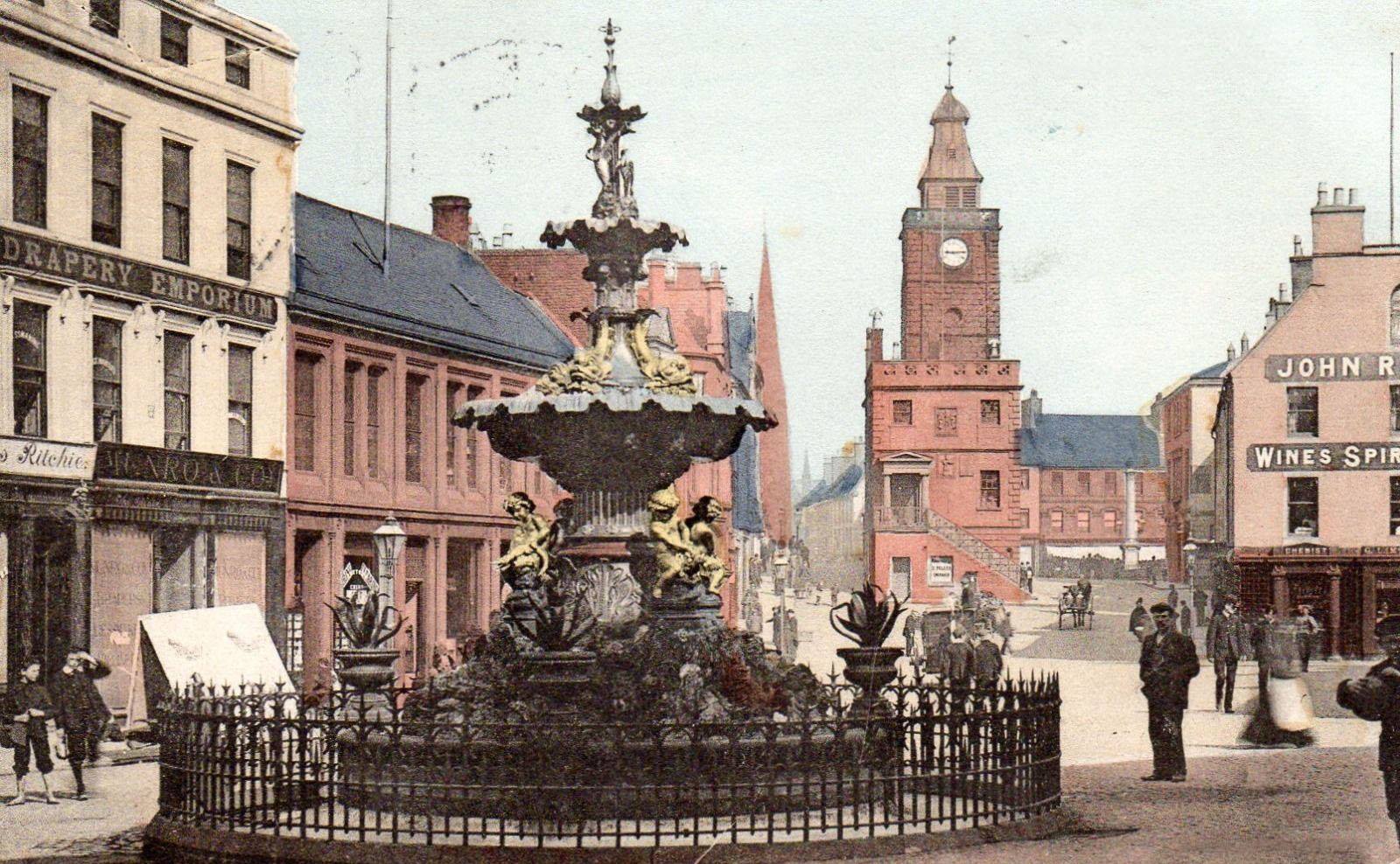
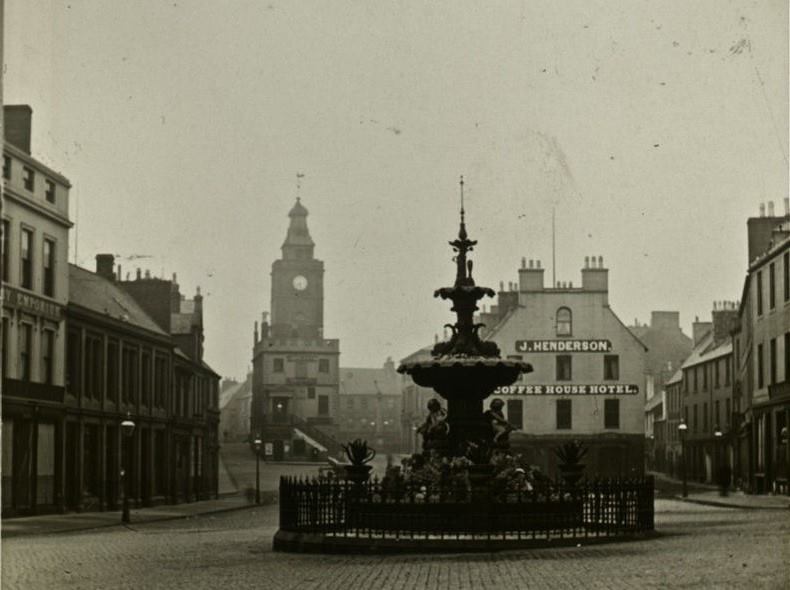
Early 1900s
“The 21st October 1851 was chosen to introduce water from Lochrutton. Midsteeple bells rang, music from the Annan band played and flags flown”. “A fountain was erected between the Kings Arms and Commercial Hotels being the principle place of resort for the congregated crowds” “This structure, formed of fire clay is in a Roman style of art with Grecian ornaments and is very handsome”
The opening ceremony was performed by Provost Nicholson and was not without incident. When the Provost turned the valve, water shot into the air and descended to soak the assembled citizens!
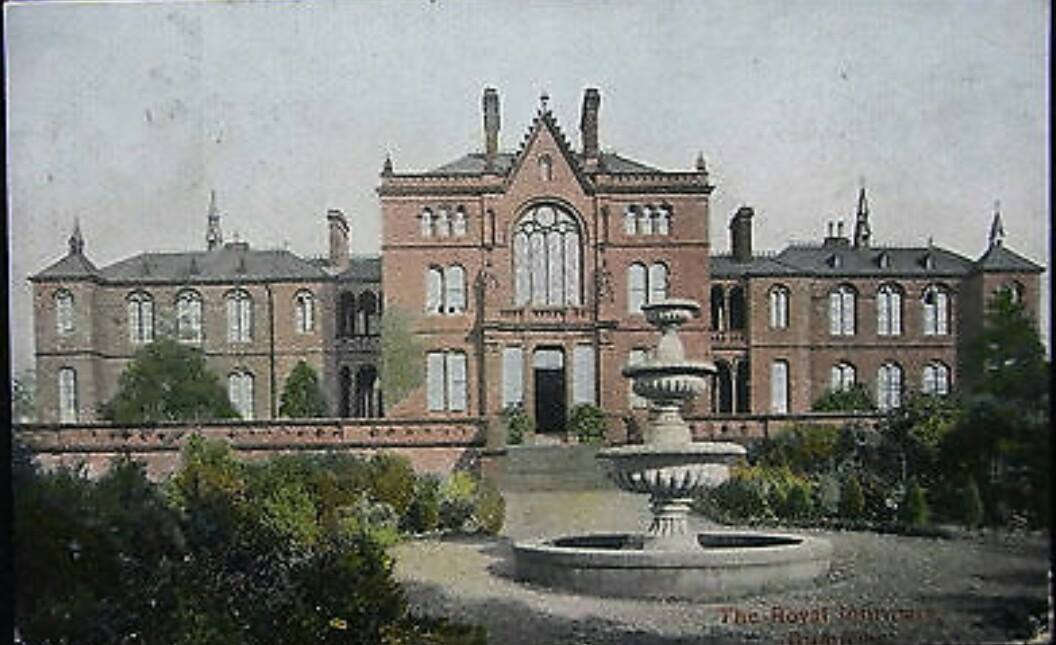
This fountain was only ever intended to be a temporary fixture and was moved to Nithbank Hospital when our current fountain was unveiled 30 years later.
The fountain is no longer at Nithbank and further investigation is needed to uncover its current whereabouts.
Original fountain sited in Nithbank
The district council funded the purchase of the new fountain from the Sun Foundry, while donations from the townspeople of Dumfries paid for its decoration. A total of £191.0s 6d from 221 subscribers was raised. The fountain was a glorious sight to behold and the townsfolk crowded onto the High Street to witness the unveiling. The Dumfries and Galloway Standard dated 6th December 1882 describes the fountain in vivid detail.
Brilliant painted photo showing original colours
“The boys, the dolphins and the storks are entirely gilded and look to be figures in massive gold. The ground of the fountain is bronzed with some of its conventional details displayed in gold. On four pedestals in the freestone basin are placed as many iron vases holding each a large iron cactus, coloured so cleverly after nature, that many who saw them thought they must be real.” – where are these cacti filled vases now?
Boys at the Fountain 1900
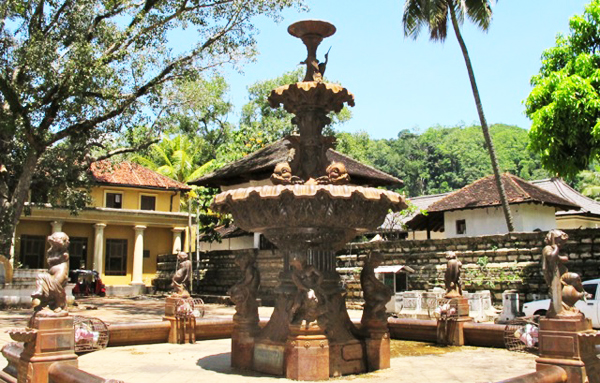
In an amazing coincidence, the town of Kandy in Sri Lanka has an identical twin fountain! The inscribed dedication on the fountain reads “Erected by the Coffee Planters of Ceylon in Commemoration of the visit of Albert Edward, The Prince of Wales (1841-1910) to Kandy December 1875.” The Prince of Wales was the eldest son of Queen Victoria (1837-1901) who succeeded his mother as King Edward VII (1901-10). It was recently renovated and ceremonially bequeathed to the public of Kandy in June 2013.
Prince of Wales Fountain in Kandy, Sri Lanka
Our fountain is a hugely important part of our social history. It marks a turning point for our ancestors, the people of Dumfries. It currently stands in a very sorry state with peeling paint and green algae. This once celebrated jewel of Dumfries town centre needs our help. Sadly, due to budget cuts, the maintenance of the fountain has not been a priority for the local council. Therefore, it falls to us to rescue it and bring it back to life.’
Jimmy Russell has been working as part of the Our Norwegian Story (ONS) project since the beginning of this year, researching and compiling stories and histories of Dumfries’ Norwegian Connection. Following a recent call out, Jimmy is also closing the ONS Trail Launch this weekend, with his performance, My Dumfries Story at 6pm this Saturday, 15th April.
‘The research I have been doing for Our Norwegian Story has been surprisingly broad, bringing together stories of Norwegian soldiers’ military, sporting or romantic exploits and the legacy of each. Between scanning photographs from Dumfries Museum’s collection and scouring the Ewart Library archives, I have interviewed Doonhamers with memories or memorabilia from the 1940s. These folk have lent some personality to what could otherwise have been an interesting yet passionless exercise.
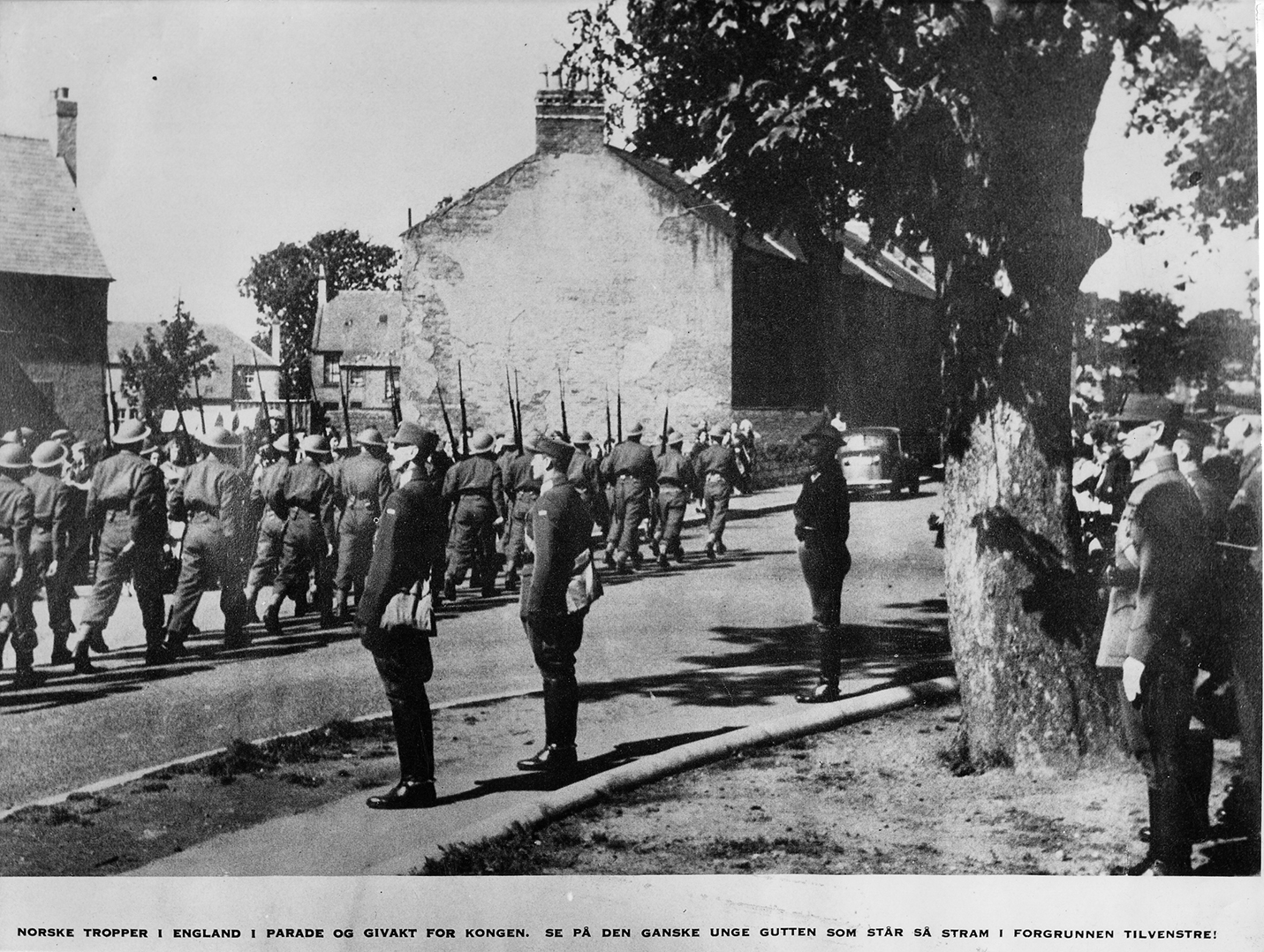
King Haakon reviews forces, troqueer Holm Field march past 1940
One of my favourite discoveries was tracing, through use of old photos and digital maps, the route that Norwegian arm recruits marched from their training ground at Troqueer Holm field to their base at the old mills in 1940 during King Haakon’s visit. At the intersection of Rosefield Road and Pleasance Avenue the king was photographed standing by a tree as his troops went by, and that spot hasn’t changed much in the past 77 years! Another special moment for me was finding images of a football match between Norwegian and Polish soldiers, probably during 1941-42 Inter-Allied tournament, which took place on the playing field of St Joseph’s College – my old secondary school!
While writing the website content for ONS I have been inspired by personal stories I have heard as much as learning about the broader situation of Norwegians fleeing to Britain. With My Dumfries Story I want to create an accessible and emotive link between those fading individual memories and the official history. By sharing the journal entries of an imaginary Norwegian living in wartime Dumfries I want to draw a composite sketch of the exile experience. Part of this process has been retracing the steps of Norwegians between various points on the trail and wider map, trying to walk in the boots of those welcome foreigners and capture what might have been felt in writing and drawing.
My background includes a degree in Scottish history and philosophy, museum and art gallery work, as well as creative writing and performance. I am also well travelled and interested in issues of migration. Hence the experience of working on Our Norwegian Story and My Dumfries Story in parallel has been both professionally and personally rewarding. I hope the results generate a greater interest in the rich, surprising history of Dumfries, but also in oor toon’s place within international contexts.’
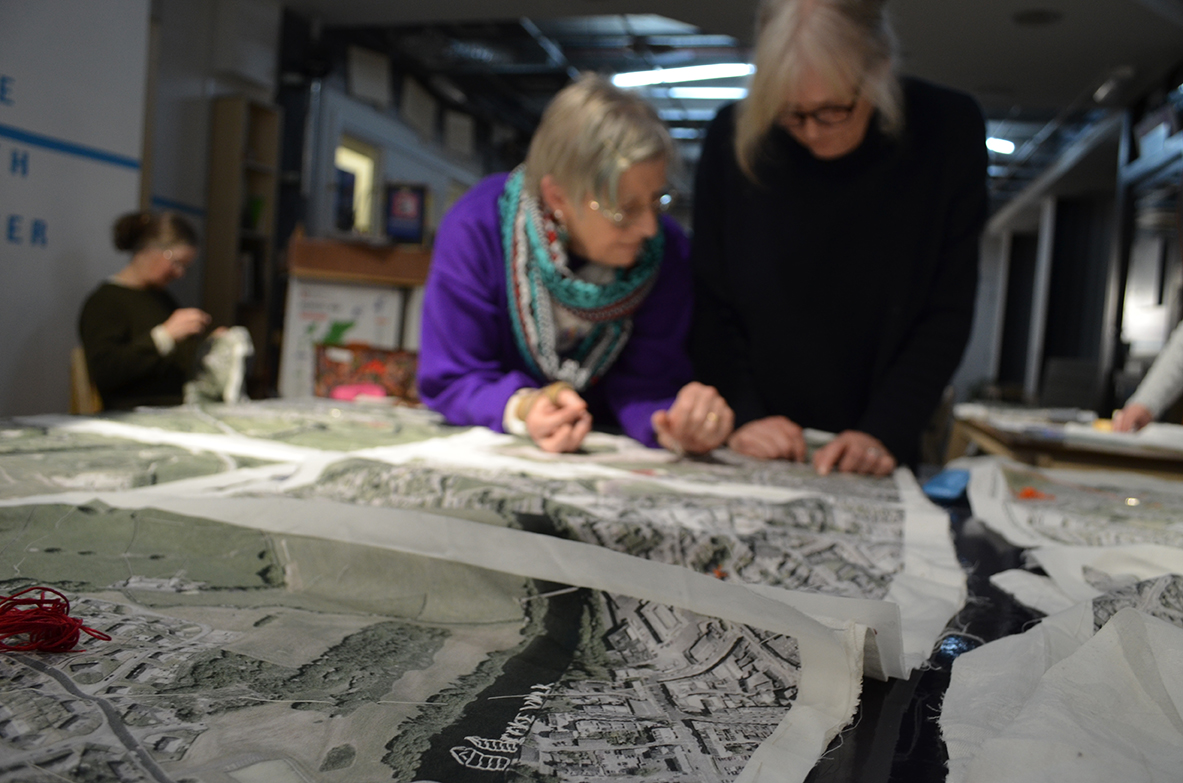
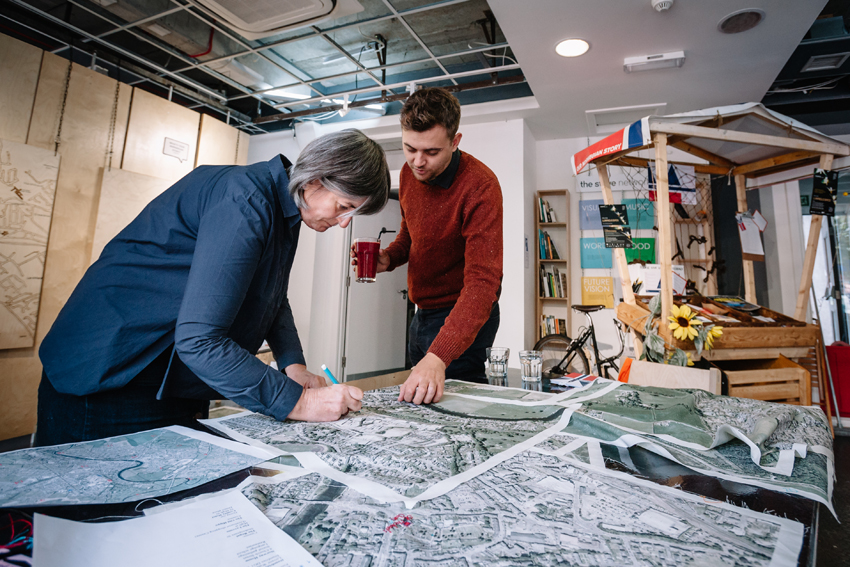
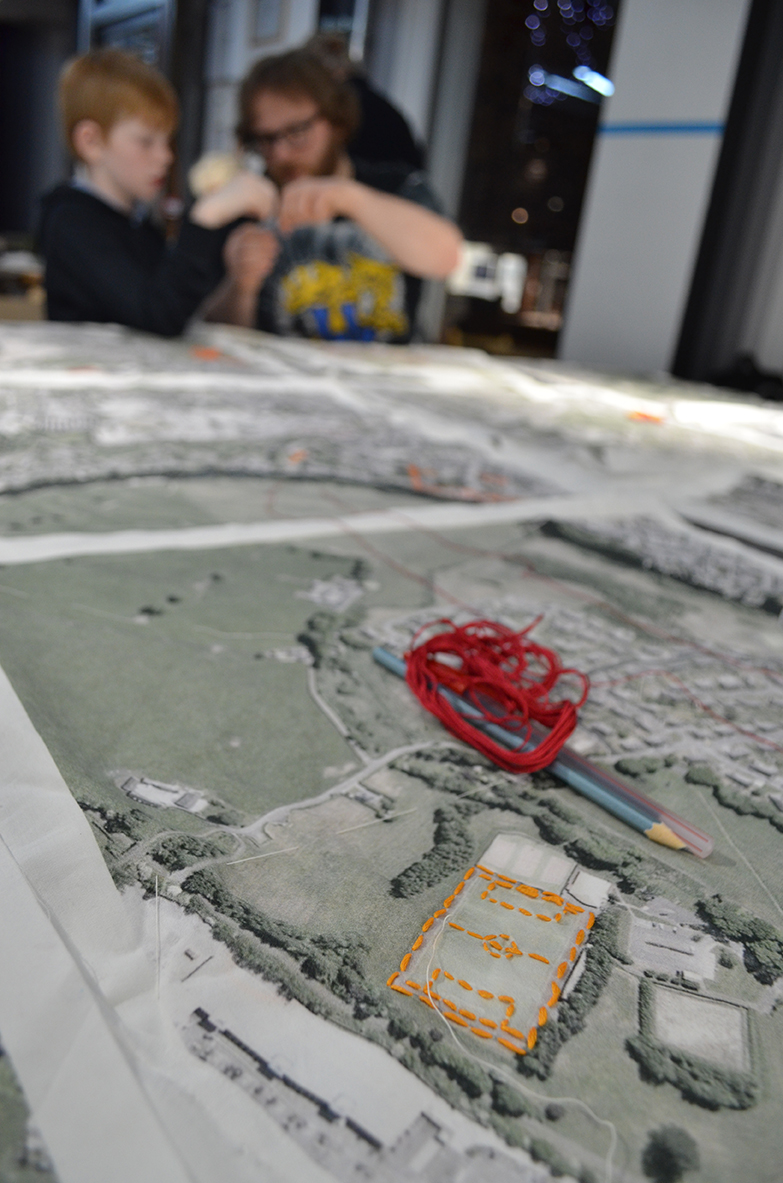
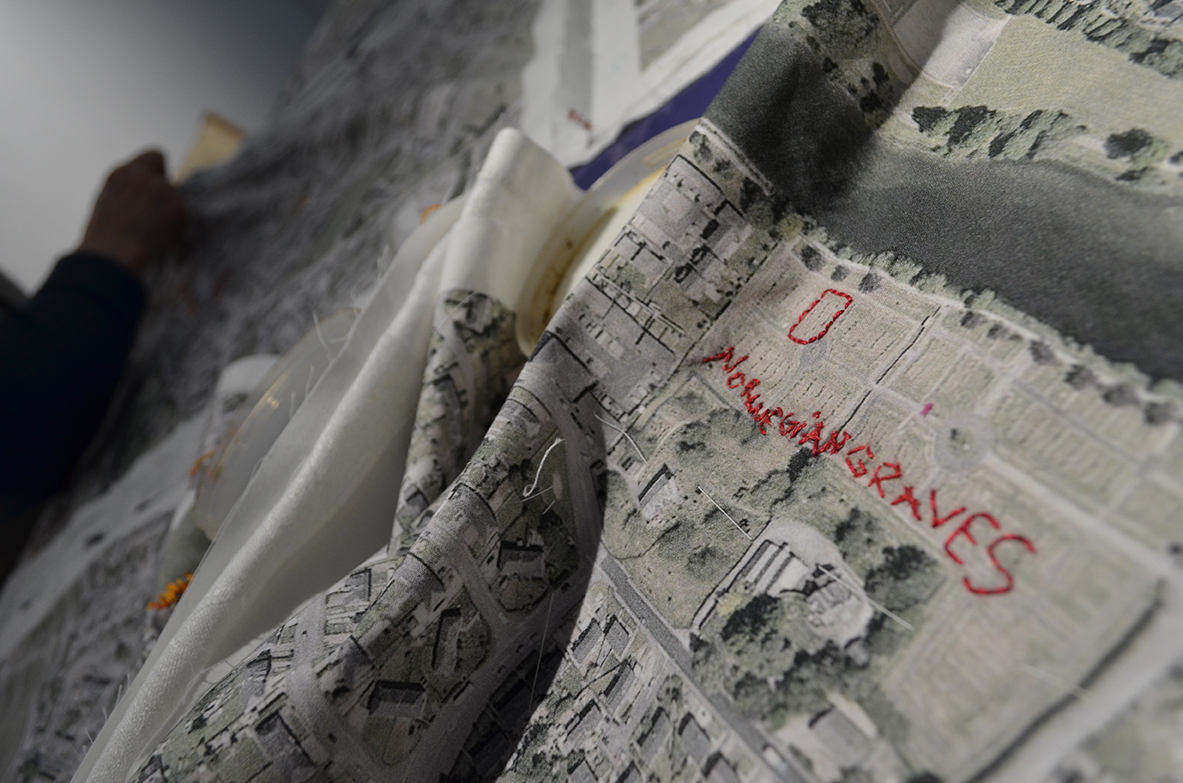
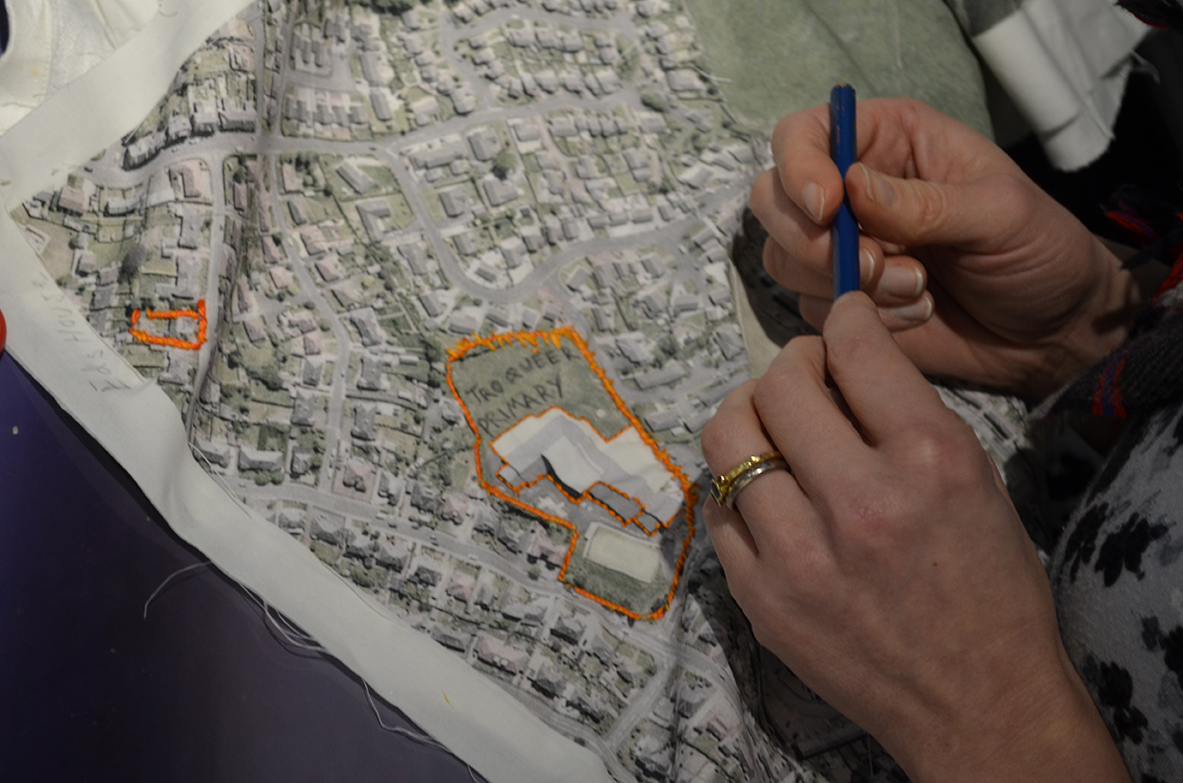
What started off last Autumn as part of Mapping Our Norwegian Story workshops has taken on a life of its own through the Stitching Our Story open stitching sessions – artist Deirdre Nelson joined the ONS team to kick start a series of hand stitched maps of Dumfries, which have now been adopted by local historian Alyne Jones and the Dumfries Embroiderer’s Guild in a fast growing project to map contemporary Dumfries through the stories and histories of the town.
The Norwegian connections are mapped out across the 20 panels that make up the map, along with other significant and personal places – local schools, homes, historical sites and transport links all feature.
Following on from successful evening workshops in February, Stitching Our Story continues into March, and all are welcome to stop in to the Stove cafe and add their own mark to the map. First drawn and then stitched over, everyone is welcome – Norwegian connections or otherwise – from experienced sewers to beginners.
Stitching Our Story is part of our ongoing Our Norwegian Story project, which has seen various events and activities exploring Dumfries’ Norwegian connection, culminating in the launch of a new Trail around the town in April 2017. For more details on the project, visit our ONS page here
To come and help add your marks to the map, or to just see how work is developing, stop by the Stove cafe on Wednesday afternoons between 3.30 and 5.30pm. Contact Katharine katharine<at>thestove.org for more details.
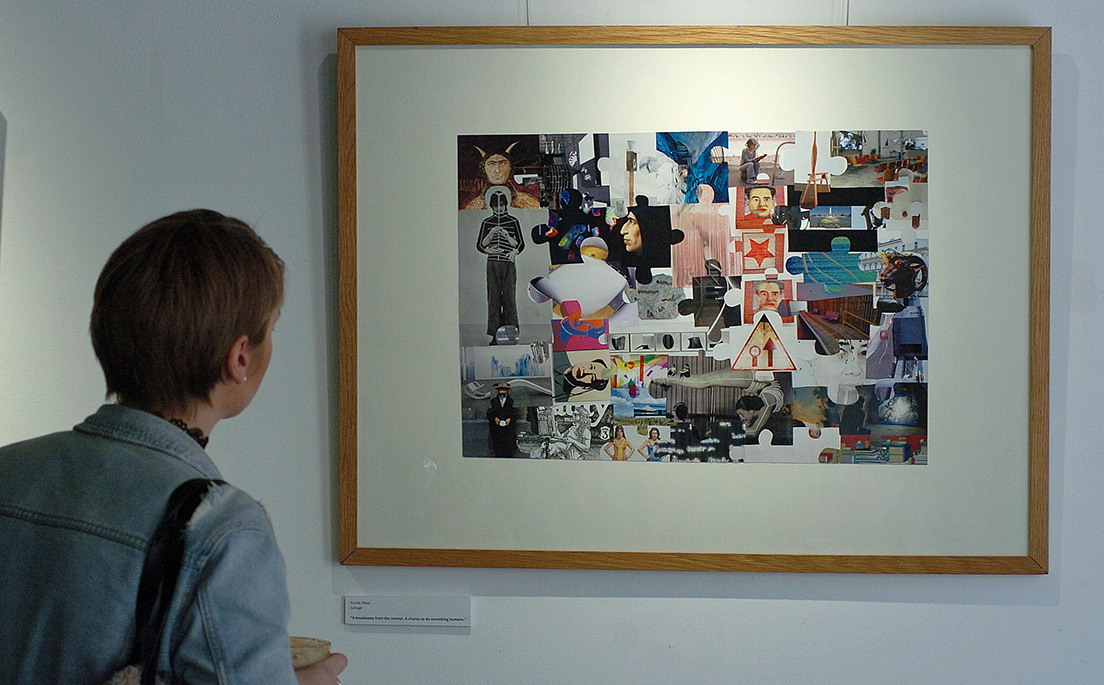
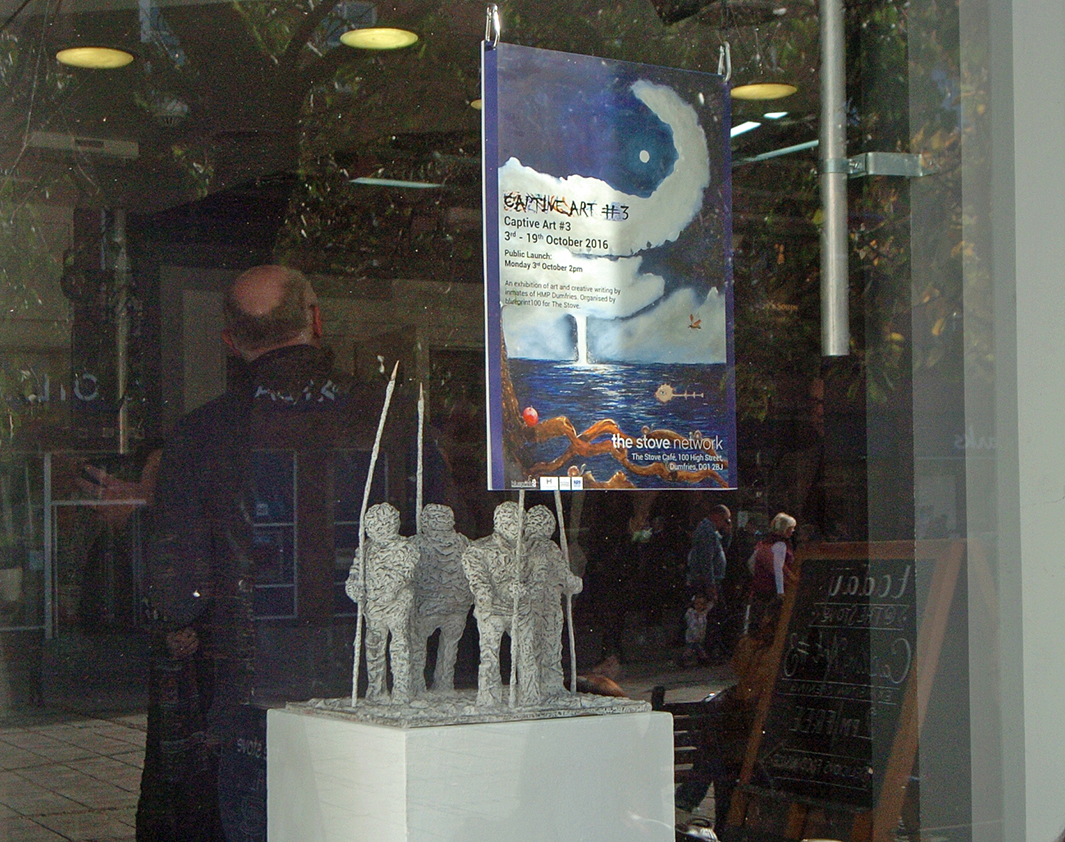
From Morgan Hardie, emerging artist and curator of the recent exhibition Captive Art #3 in the Stove cafe:
I am a portrait artist based in Dumfries, I graduated with a HND in Art and Design three years ago at Dumfries and Galloway College and have continued since then as self-taught. I have a huge interest and wish to pursue a career in the therapeutic arts, which is why I was really excited when I was offered the opportunity to curate Captive Art #3! I believe it is so important that the prisoners have the chance to show their work outside of prison walls and to offer the local community a better understanding of prison rehabilitation, and how art practice and creative writing play a fundamental part in this.
The experience of curating the exhibition was so busy and enjoyable, I loved all of the different aspects from selecting the work in Dumfries Prison to hanging the exhibition the day before the opening. I had written out a plan covering everything that needed to be done and how I was going to do it, and with some help from blueprint100 and the prison education department, I think I managed to stay fairly organised! Selecting the artwork was probably the most challenging, as there was a huge variety to choose from and such limited wall space in The Stove Café, but I managed to really narrow it down and include work which demonstrated a range of different styles and techniques.
The reason I chose the painting called ‘The Nearest Faraway Place’ to be used on the posters and invites, apart from it being my personal favourite, was because of the story behind it and the immense detail portrayed. The artist had explained to me that the painting was a representation of a dream he’d had, and he had felt the need to paint it on to canvas.
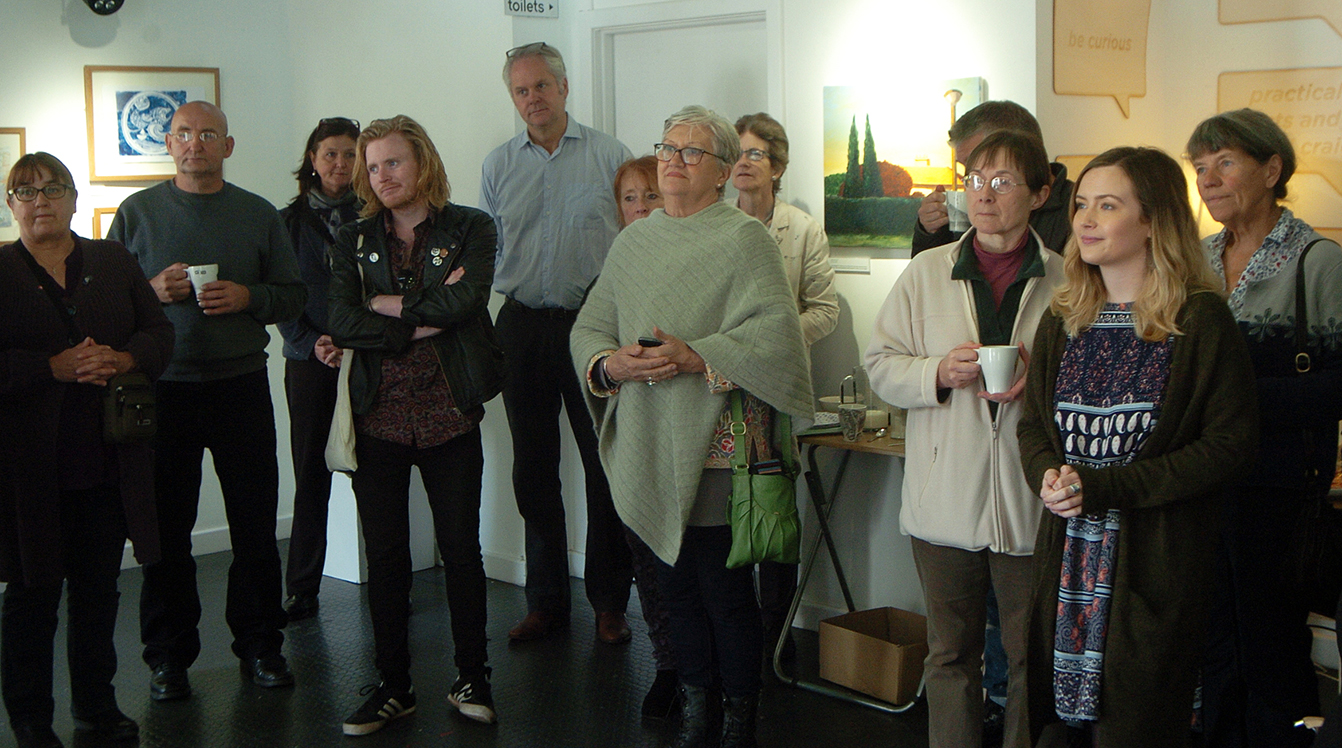
My main goal was to involve the prisoners as much as possible, as it is their exhibition after all. I took information about The Stove up to the prison, along with photographs of the space so that they were clued up on where their work was going. I had decided to keep all of the work anonymous, but instead had asked each artist for a small statement on what art does for them on a personal level and included this on their labels. I received really good feedback at the opening event about this personal touch, as well as the prisoners’ poems which were read out at the beginning and the other written work which was also on display. I found that the visitors really liked that interesting connection between art and writing as it helps them to gain a more informative insight, which is exactly what I had hoped for.
The opening event was more successful than I imagined it would be, and I hope the exhibition continues to deliver and inform for the remaining time that it is on display. Hopefully everyone enjoys the exhibition as much as I loved curating it!
Jordan Chisholm is a student at Royal Conservatoire of Scotland studying Contemporary Perfomance Practice. She is currently doing a placement at The Stove and writing a blog about her experience with us – this is her first post..
Jordan (with blue hair) performing in the Salty Coo performance she co-designed and produced with Dillon Colthard for The Stove’s Nithraid 2016. Photo Kirstin McEwan
When I was thinking about where I wanted to do my placement for third year – I had no doubt in my mind that I wanted to do it in Dumfries. I moved to Dumfries, in 2012, when I was seventeen years old. When I left school, I had a university offer to do Criminology but I wasn’t entirely sure if this is what I wanted to do. My mum has stayed in Dumfries for around fourteen years and it was decided that I would move in with her, to be in a new environment with no one I knew.
I’d visited Dumfries many times at the weekends and over school holidays but living there on a daily basis was something extremely different. I wasn’t sure how I felt about the town. As an ‘outsider’ coming from Edinburgh; I felt as though I really did not belong in this beautiful space and I could not explain why. I guess this was something internal and I spent most of my first year living in Dumfries travelling back to Edinburgh; there was something I was not prepared to let go and starting a new life was not as simple as I had anticipated.
Time passed and I began to open my mind. I met new people and started to do new things. I began to explore Dumfries in a new way; it was like a playground – full of magic, wonder and uncertainty. I still feel much of that uncertainty today – over four years later. However, I am not scared by this anymore; instead it inspires me and it always leaves me wanting more.
Dumfries changed me. It changed the way I look at things, it changed my opinions, it gave me a platform to do things I never thought I was capable of doing, it gave me something to be passionate about, it allowed me to learn about myself and who I could be, it shaped my future, my hopes and my dreams; Dumfries changed my life. But could I change Dumfries?
When I think about what I may want to do in the future; giving something back to Dumfries is at the top of my list. You see, in this misunderstood town, where there may not be very much to do, there are hundreds of people who all share the same love and understanding of what this space really is. Dumfries has a strange pull to it; and this pull is of upmost importance to the future of the town. We have to work together to allow people to feel proud of where they come from – to make them want to stay. This is what I want to be a part of. A part of the regeneration of Dumfries through art, creativity and sheer hope. I want Dumfries to give everyone what it gave to me, and I don’t want them to have to look very hard to get what they are looking for.
The Stove Network is situated in the centre of Dumfries. It is a fully accessible public arts space/facility/resource for the population of the town and the wider region. It is a support network that creates opportunities and connections for the creative community and integrates with the local economy and wider society. One of The Stove’s aims is to use the arts to engage and empower people for themselves, the places they live and society at large. This aim is vital to my own learning and development; I knew that this was where I had to be for placement. I wanted to know how they manage to do what they do in a town that says no much more than it says yes. I wanted to live and breathe their commitment to the Dumfries community and I wanted to be around people who share the same desires as I do; who can show me how to make a positive difference with an understanding of the quality in process as well as the product.
Although I knew why I wanted to be at The Stove, I was still extremely nervous on my first day and I did not know what to expect. It reminded me of my earlier ‘outsider’ feelings but I pushed these to the side and arrived with no expectations as to how my first week may turn out.
I was met by curator, orchestrator and public artist; Matt Baker. The motivation for Matt’s work is to have an effect in the place for which it is made. I find it comforting and reassuring having the opportunity to be mentored by someone who vocalises that they became an artist to change the world.
We use cookies to improve your experience on our website, analyse traffic, and personalise content. By using our site, you consent to the use of cookies. Please read our privacy policy for more information.
Cookie Preferences
Manage your cookie preferences below:
Essential cookies enable basic functions and are necessary for the proper function of the website.
Name
Description
Duration
Cookie Preferences
This cookie is used to store the user's cookie consent preferences.
30 days
Statistics cookies collect information anonymously. This information helps us understand how visitors use our website.
Google Analytics is a powerful tool that tracks and analyzes website traffic for informed marketing decisions.
Contains information related to marketing campaigns of the user. These are shared with Google AdWords / Google Ads when the Google Ads and Google Analytics accounts are linked together.
90 days
__utmx
Used to determine whether a user is included in an A / B or Multivariate test.
18 months
_gali
Used by Google Analytics to determine which links on a page are being clicked
30 seconds
_ga_
ID used to identify users
2 years
__utma
Used to distinguish users.
Persistent
__utmb
Used to determine new sessions/visits.
30 minutes
__utmc
Used to determine if the user is in a new session/visit.
Session
__utmt
Used to throttle request rate.
10 minutes
__utmv
Used to store visitor-level custom variable data.
2 years
__utmz
Stores the traffic source or campaign that explains how the user reached your site.
6 months
_ga
Used to distinguish users.
2 years
_gat
Used to throttle request rate.
1 minute
_gid
Used to distinguish users.
24 hours
Clarity is a web analytics service that tracks and reports website traffic.