Support Us
Categories
Musings News

Creativity and Community as Part of the National Recovery

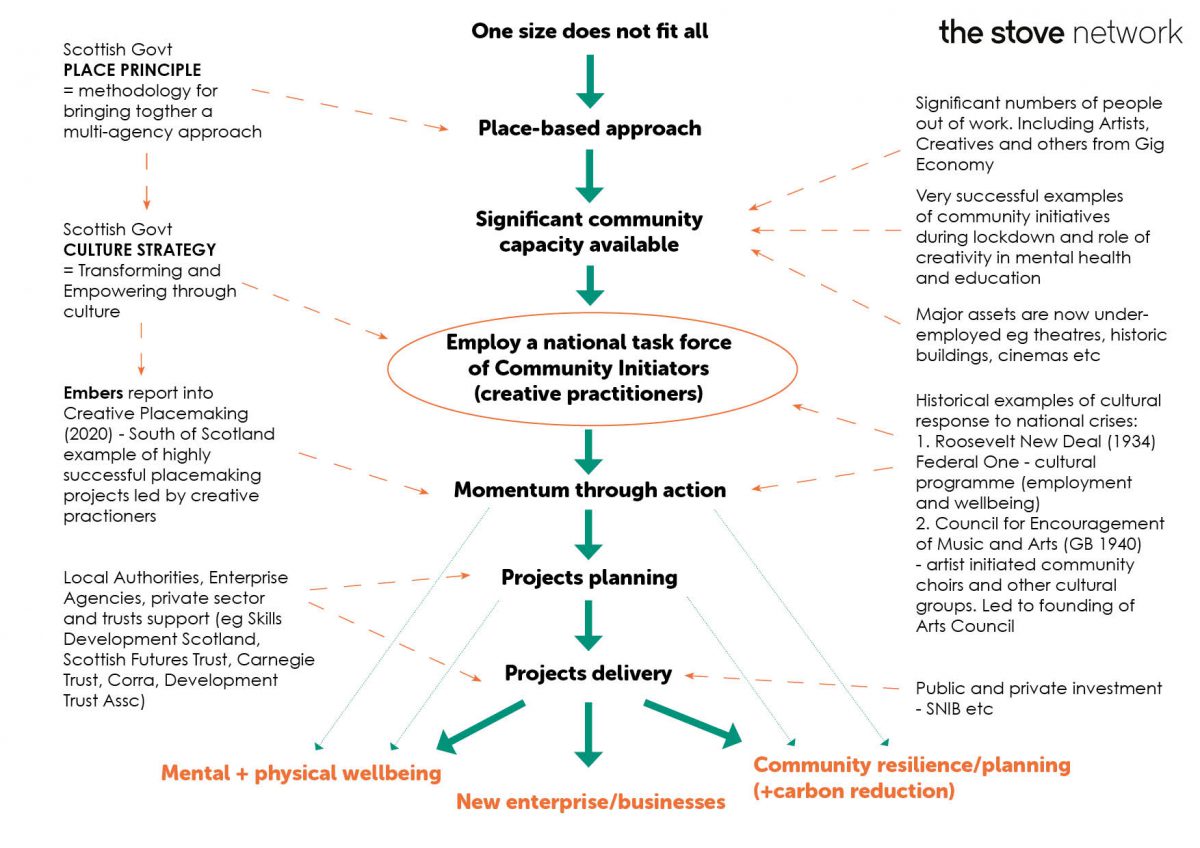
The diagram above is The Stove’s submission to The Advisory Group for Economic Recovery for Scotland. It is just the first germ of an idea and we are sharing it now in the hope of generating further discussion with others in the Creative and Community sectors.

Download a full-size version of the diagram here

The premise is simple – our Embers report has clearly shown the pivotal role played by creative practitioners and small creative organisations to initiate and maintain momentum in placemaking projects. These may start with cultural projects, but quickly develop into new social enterprises, asset-based and environmental initiatives. In short – do some cultural pump-priming in a community setting and the payback in terms of community resilience, economic development and people’s wellbeing is incredible.


In the current climate we have thousands of creative practitioners with little prospect of working in the short and medium term. We have communities who have experienced working together for mutual benefit during lockdown and we have many brilliant resources (theatres, sports centres etc) that are lying temporarily idle.

What if we were to pay out of work people in the Creative and Community sectors a Basic Income to work in their local communities to start new projects (or build on things started in lockdown) – these could be cultural projects like choirs, writers groups…but they could also be environmental projects or new social enterprises. Our skill set is to ‘make shit happen’ we are producers, innovators and entrepreneurs! If this National Task Force was to get things started then the national agencies and funders could come in behind and help take things to the next level and, before you know it you have communities making their places, economies and health better.


It may sound mad, but something not so very different was successful in the US as part of Roosevelt’s New Deal in 1934 and again in 1940 in Britain with the Council for Encouragement of Arts and Music which saw a force of musicians staring choirs and orchestras all over the country during wartime.


That’s as far as we’ve got til now – whaddyfink? Let us know and help us shape the idea if you think it has legs..

Categories
News

Creative Placemaking – a Local Phenomena in the South of Scotland


A major report into Creative Placemaking by The Stove Network has recently been released. It presents an in-depth investigation into the importance, impact, and potential influence of Creative Placemaking for the local economy and well-being of communities in the South of Scotland.

The Embers Report aims to ignite creative and culturally led regeneration by exploring the work and experience in Dumfries and Galloway and helping to define a joined-up vision for work in Creative Placemaking for the South of Scotland. Embers presents Creative Placemaking as a collaborative practice that uses the tools of arts, culture, and creativity to work as part of our communities, responding to local needs to build a better quality of place.

In this time when community responses and collective action are at the front of everyone’s minds, there has been a long history of community activity in the South of Scotland, with people coming together to look at the future of their towns and villages. A common factor across many of these projects is the involvement, and often leadership, of creative people who are already embedded in their communities and in collaborative activity with the arts, culture, and creative industries.

“What we hope is that the Embers Report will be a map, advocacy document and proposal for support needed to further advance the really great work in placemaking that we can see happening in our communities. People are doing amazing things as part of their communities, bringing all sorts of life experience, expertise and ideas together to make a better place for everyone who lives there. Ideas don’t always work but when they do they are making a real difference in people’s lives.”

Katharine Wheeler, Curatorial Team Member and lead on the Embers report.

The Embers Report was produced with the support of the South of Scotland Economic Partnership (the forerunner of the new South of Scotland Enterprise agency) and the Carnegie Trust UK. Embers involved six-month detailed consultation with people and projects working in local communities, including Dumfries, Sanquhar, Lockerbie, Langholm, Moniaive, Stranraer, and Wigtown.

With the coming of the Borderlands Growth Initiative and South of Scotland Enterprise, there is an unprecedented opportunity for the South of Scotland to create genuinely bespoke development strategies, suited to its unique character. Creative Placemaking should be at the heart of this, through the way that communities are coming together to develop new social enterprises and place-based projects.

“We hope to continue to support Embers to strengthen local government collaboration with community groups and local enterprise, to enable communities to improve their own wellbeing according to local priorities.”

– Pippa Coutts, Research and Development consultant for Carnegie Trust UK.

The Embers Report puts forward a series of clear recommendations which contributors hope will be taken forward by regional and national agencies operating in the South of Scotland.

Effective Creative Placemaking engages communities at the grassroots level, building on the existing culture, activity, and relationships in each place. It brings people, communities, groups, and organisations together to co-develop better strategies for our places. It utilises the Creative Industries and spans Community Development sectors, contributing to long-term social outcomes for our communities.

The Creative Industries play an important role in our towns, particularly at this time. It is vital that our region supports its creative sector, which has been such a success story in recent years. There are currently more people working in the Creative Industries in the South of Scotland than there are in agriculture, yet many of the people working in this industry are freelance and self-employed, and the COVID-19 crisis has taken a terrible toll on these important local businesses. The Embers Report presents a roadmap for integrating creative businesses into communities and the future inclusive economy of our area.

“How can we, as a creative agency for change, make things slightly different here.”

– Lucy MacLeod, Creative Director for Outpost Arts, Langholm

The Embers report is available to download by here: Embers Report  

For a Clear Text Version: Embers Report – Clear Text Version

If people have ideas about how this vision can be taken forward, please do get in touch with Katharine by emailing [email protected]
Categories
Musings News Project Updates

homegrown – an introduction

With the out-break of COVID-19, we face a shared reality that will live on in the minds of this and further generations in pictures, stories, songs and memories. We are faced with questions we never foresaw answering.

In this time of social distancing, The Stove’s field of operation for community, creativity, care and gathering within spaces both shared and public is now radically altered, without objection. Isolation, distance and confinement are the new normal.

The priorities have shifted. The Stove has always functioned in collaboration; collaboration with communities, with artists, with other arts and community organisations, with policy-makers and as a team. In addressing this new normal we propose four values that will frame our work:

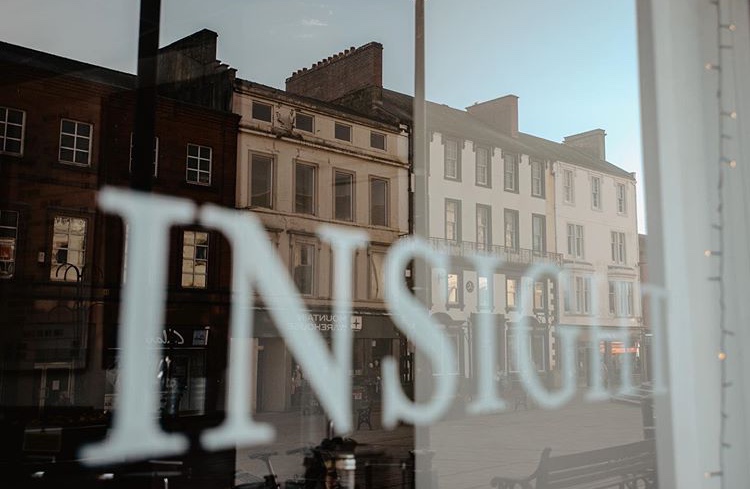
Insight
Perseverance
Open-heartedness
& Solidarity

Over the coming weeks, we invite you to explore with us these values through a series of creative challenges, conversation, commissions and activities that can be done in isolation and through connecting with one another via the internet and in so doing, build and maintain resilience in the present, as well as build hope and strategies of change for the future.

We choose to acknowledge and ask the right questions, host the conversations and create the new spaces where these can happen, aside from the café, pub, High Street or studio.
As humanity has always done, we will attempt to record and archive these projects, and together with our community, inspire a new folklore so that we might retain and remember this time, however it may be, for the posterity of generations’ hereafter.

Homegrown is exactly what the Stove is all about, and what it continues to be. Responsive, locally initiated, developed and owned.

As always, we are open to every idea that comes through our inbox. So please do get in touch if you would like to contribute, in any form, place or style you would like.

Categories
News

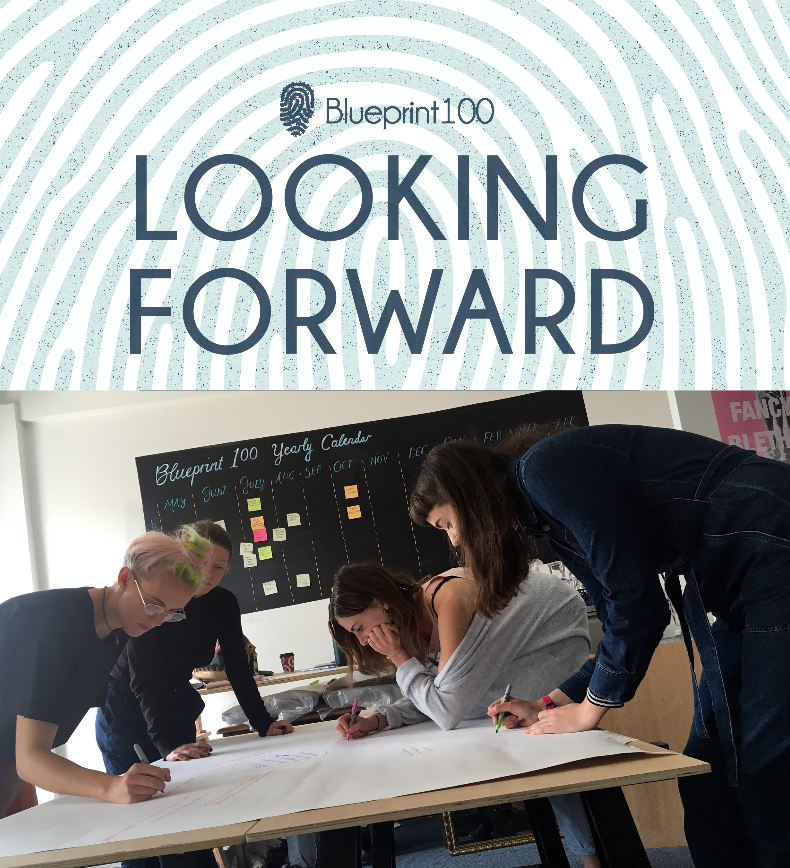
Blueprint100 Looking Forward April – September 2020

Over the next few months, we’re taking some time to reflect on blueprint100. How can we grow and evolve the learning opportunities The Stove Network offers for young creative people, and by doing so, empower those and other young people to start professional careers within the arts?

It’s been 5 years since blueprint100 initiated itself as a coveted opportunity for young creative people through a self-led approach to professional development and active working experience within The Stove Network.

This is an approach to learning and professional development aimed at supporting young people across varied stages in their work and helping to build bridges both in and out of more formal structures and other types of work and experience.

As The Stove and blueprint100 have grown and changed rapidly over the past few years we feel it is a good time to take a deeper look at blueprint100 and the learning opportunities it provides as part of The Stove team.

Through a period of consultation and reflection we will evaluate and reshape our blueprint100 framework to ensure it meets the needs of our region’s young creatives giving them the right balance of support and freedom to develop.

For this reason we want to let you know that we will not be recruiting for another blueprint100 team this April 2020 but instead taking the space for this deeper consultation and evaluation. We will do this through a series of targeted workshops and one to one interviews with past blueprint100 curatorial team members, active participants and young creatives, creative groups and organisations and relative learning bodies and service providers.

The consultation will be lead by blueprint100 mentor Katharine Wheeler who will be supported by a young person within the blueprint age range (18-30).

Please stay tuned for more updates in the near future.

Categories
Musings News

Don’t Forget the Self-Employed!

At The Stove we recognise the position and the responsibility we have within the region’s cultural, creative and community sectors. Of our 600+ members, we estimate that as many as half will be self-employed or freelancers.

With the national shutdown of the economy for COVID-19 virtually all freelancers and self-employed people have had their incomes wiped out overnight as events and regular contracts have been cancelled – people are literally facing personal bankruptcy overnight. This in contrast to people employed on PAYE who will now be supported with 80% of their wages through the Government’s national bailout package.

First off, we have written to the region’s MSPs and MPs asking them to advocate for the Scottish and UK Governments to take urgent action to support the self-employed sector.

In Dumfries and Galloway 17.2% of people in employment are self-employed, against a national average of 10.8% (source: Skills Development Scotland – Regional Skills (D&G) Assessment 2016).The vast majority of self-employed people submit a tax return every year and it would be straightforward measure to extend the 80% package to the self-employed on the basis of, say, an aggregate of their last 3 tax returns to assess average earnings. Such a measure has been adopted by Sweden and different European countries are also supporting their self-employed economies.

Currently the self-employed in the UK only have access to statutory Sick Benefit (£94 per week – if they are ill) and have been given a 6 month ‘holiday’ from advance tax payments.

The cultural, creative and community sectors have been one of the regions success stories of recent years, being one of the very few local industries that is attracting people to relocate or move back to the region. Figures show that there are now more people employed in the Creative Industries in D&G than there are in Agriculture (source: SoSEP) – this is a sector with high value jobs of exactly the sort we are trying to attract to the region through initiatives like South of Scotland Enterprise and Borderlands. It is imperative that we, as a country, act immediately to protect this vital sector within our local economy and support the people and families that rely on self-employment/freelance work.

At The Stove we know how important we are to the ecosystem of the cultural, creative and community sectors – organisations like us can function as a conduit between individual freelancers/small teams and national/international partnerships and funding – we can draw budgets into the region that are spread amongst the local sector. Typically, The Stove puts £200,000 per annum into the freelance economy of D+G. Our first instinct at the start of the health emergency was to maintain our support for the wider community around us – both the folk we work with as participants in our work, but also the wider creative community. We have been able to honour all the existing commitments we have to freelancers across all our projects (and also keep on our café staff).

Looking into the future we know only too well that the freelance community normally expect regular work through organisations like us at festivals and events. We are working hard at the moment to find ways that we can continue to deliver on projects and offer new contracts to freelancers. We are a creative community and opportunities to do useful and creative work for the local community will present themselves!

Currently we are working on ideas to bring the local cultural, creative and community sectors together at this very challenging time – in the hope that we can be a useful collective resource and also forge some self-help initiatives that will help this struggling within our own sector. If you have anything you would like to contribute then do get in touch.

Please stay tuned to the various Stove platforms for updates.

#Homegrown

Categories
News

Coronavirus Update from The Stove Network

The Stove has always been a responsive and community-led organisation, we care deeply  about our team, our membership and the community we serve. The current public health situation with Coronavirus is a serious challenge to all of us and the way we do things as a society. We have decided to take a series of measures which are listed below and would ask everyone to have a read of these and pass on the message to anyone who you think might need to know.

However, thinking about the situation in its entirety, our team’s decision is not to leap in to immediate responses. Rather, we plan to wait, be watchful and listen to those around us and work to support the efforts of the council and other agencies who are taking a lead role in managing the challenges that face us all. The Stove has always been a future-facing and responsive organisation, we will make available all of our capacity, knowledge and experience and look for opportunities for positive action and change for our community.

Public Events

From today (Monday 16th March), all Stove programming for public events is cancelled until further notice. This means that all events in our calendar that are open to a public audience will not be going ahead. We will be reviewing this policy as official advice and guidance is available as the COVID-19 pandemic develops.

Room Bookings at The Stove

For outside groups using the Stove for their own private room bookings, we will continue to offer this facility for groups. We will be making some detailed changes to the way we use rooms and protocols for hygiene. These details will be made available to individual groups prior to their event.

The Stove Cafe

We are aware of the fast changing situation with regard to cafes and bars. For the time being we will keep the Stove Café open. We’ve discussed this with our staff who feel comfortable and confident. Everybody at the Stove feels that the community function of the café is important to people and that we should offer this facility for as long as possible. We will be keeping a close eye on national guidance and anticipate that the café may have to close in the near future, until then we have reduced the number of tables to allow folk to remain further apart and introduced additional hygiene measures around payment systems etc. The coffee will remain awesome!

In the meantime please stay safe and look after each other – if there is anything that you feel The Stove could be doing or you would like to contribute to our thinking about how to act in the future, please do get in touch.